Occupation Studies Research Network

4 November 2021

Over the past few years I have researched and written about the British Occupation of Germany after the Second World War.

More recently, I have become interested in comparing this with examples of occupation in other parts of the world. What can we learn from studying other cases of Military Occupation? Some aspects are very different, but it is surprising how the same themes and issues arise. The answers may be different, but the questions to ask – about the lived experience of occupation, personal relations between occupiers and occupied, the ruling techniques of the occupiers, the memories and legacies of occupation – are often the same. 

After publishing the book Transforming Occupation in the Western Zones of Germany, a collection of articles by sixteen international scholars about the British, US and French Zones of occupation in Germany, Dr Camilo Erlichman, Assistant Professor at the University of Maastricht in the Netherlands, and I have now launched a new Occupation Studies Research Network, which is intended to act as hub for the global community of scholars working on military occupation as a form of alien rule and as a dynamic power relationship between occupiers and occupied.

Over fifty scholars from around the world have joined in the two months since the Network was launched on 1 September this year. If you would like to know more, have a look at the About page on the Network web site and the articles on the Network Blog 

Five articles have been published on the blog so far, all of which are well worth reading::

Occupation Studies: A Manifesto by Camilo Erlichman

Second Class Occupiers? by Félix Strecher, PhD Researcher at Maastricht University

Military Government as a System of Rule: Peculiarities and Paradoxes by Dr Peter Stirk, who has recently retired as Senior Lecturer in Government and International Affairs at Durham University

On Horses and Bases: Traces of the American Occupation in Contemporary Germany by Adam Seipp, Professor of History at Texas A&M University, USA

Labour Law, Military Occupation and Industrial Democracy by Rebecca Zahn, Reader in Law at the University of Strathclyde, Glasgow

Foe to Friend – Exhibition at the National Army Museum, London

4 December 2020

Thank you to everyone who attended my on-line talk today on Reconstruction, Renewal and Reconciliation in Occupied Germany after the Second World War. The talk was part of a programme of events to complement the exhibition at the National Army Museum in London: Foe to Friend on the history of the British Army in Germany since 1945.

As a former General Officer Commanding British Forces in Germany said a few years ago, after the announcement was first made that the British Army would no longer keep a permanent base in Germany: 'Now we are leaving Germany, perhaps we should discover a little more about why we arrived here in the first place.'

The talk was recorded, so if you missed it, you can view it here.

If you have any comments or questions, feel free to add comment to this post or send me an email.

Marriage with ‘ex-enemy nationals’ (continued – part 10) – Why did the British Government end the ban?

19 May 2020

In this final post on the theme of British soldiers and administrators and German women who met soon after end of the Second World War, fell in love and decided to marry, I’ll try to answer the question: why did the government in London announce, on 31 July 1946, that the ban on marriage with so called ‘ex-enemy nationals’ would be relaxed, after marriage between British servicemen and German women had been forbidden for over a year, since US and British troops first crossed the border into Germany in late 1944 and early 1945.

In previous posts on this blog I tried to answer the questions: how many marriages between British men and German 'ex enemy nationals' were there in the first few years after the war, and who were the first couple to marry?

The decision to end the ban was taken at three Cabinet meetings in May and July 1946, against the wishes of the British military authorities in Germany. The Government responded to pressure from MPs, who argued that men and women should be free to marry whoever they chose and the state should not interfere in the private lives of individuals. Ministers received legal advice that, according to British law, marriages conducted without official permission were still valid and decided that, as they could not prevent marriages taking place if a couple were determined enough, it was better to end the ban.

The marriage ban was first implemented as part of a package of non-fraternization measures issued by SHAEF, the Supreme Headquarters of the Allied Expeditionary Force – the joint US, British and Canadian armies under the overall command of General Eisenhower, that liberated France in 1944 and invaded and occupied Germany in April and May 1945. The policy of non-fraternization with German civilians was outlined and justified in the SHAEF Handbook Governing Policy and Procedure for the Military Occupation of Germany, issued in December 1944. Chapter 14 of the handbook, headed ‘Policy on relations between Allied occupying forces and inhabitants of Germany’ stated that:

‘There will be no fraternization between Allied personnel and the German officials or population … They must learn this time that their support and tolerance of militaristic leaders, their acceptance and furtherance of racial hatreds and persecutions, and their aggressions in Europe have brought them to complete defeat, and have caused the other peoples of the world to look upon them with distrust.’

The marriage ban was a consequence of the non-fraternization order. The British Soldier’s Pocketbook, issued in early 1945, reminded soldiers that: ‘Your Supreme Commander [General Eisenhower] has issued an order forbidding fraternization with Germans’. A separate section headed 'Women' warned soldiers of the supposed dangers posed by German women:

Numbers of German women will be willing, if they can get the chance, to make themselves cheap for what they can get out of you. After the last war prostitutes streamed into the zone occupied by British and American troops. They will probably try this again, even though this time you will be living apart from the Germans. Be on your guard. Most of them will be infected.

MARRIAGES BETWEEN MEMBERS OF BRITISH FORCES AND GERMANS ARE, AS YOU KNOW, FORBIDDEN. [Capitals in the original]

But for this prohibition such marriages would certainly take place. Germany will not be a pleasant place to live in for some time after the war, and German girls know that, if they marry British husbands, they will become British with all the advantages of belonging to a victor nation instead of to a vanquished one. Many German girls will be just waiting for the chance to marry a Briton.

The equivalent booklet issued to American troops, ‘Pocket Guide to Germany’ was equally forthright about fraternization:

There must be no fraternization. This is absolute! Unless otherwise permitted by higher authority you will not visit in German homes or associate with Germans on terms of friendly intimacy, either in public or in private.’

But a separate section in the US Pocket Guide, headed ‘Marriage Facts’ was more ambiguous, suggesting that marriage was not prohibited outright (despite the absolute ban on fraternization).

Now that you are on foreign soil, you should know that marriage to a foreign girl is a complicated procedure. Before you get too romantic remember that foreign girls do not automatically become citizens upon marriage to an American … In any case, you cannot marry without the authorization of your commanding officer. Even with this permission you would have difficulty getting your wife back to the U.S. since there are no provisions for transporting dependents during wartime, nor are there likely to be for a long time to come.

This ambiguity in the US Pocket Guide over whether marriage with the former enemy was possible or not, despite the non-fraternization orders, was reflected in high level discussions that had taken place earlier between senior British and American legal officials and civil servants, although in this case the roles were reversed with the US, rather than the British, taking a harder line. The Americans proposed in October 1944 that SHAEF should issue a military government law, applicable in the part of Germany occupied by US and British forces, that would not only order soldiers not to marry Germans and punish them if they did so, but invalidate any marriage performed against the law, making it ‘absolutely null and void’. 

However, before the law was issued, the British Foreign Office stepped in and prevented its formal promulgation, on the basis that British government ministers had not had the opportunity to consider it. The matter was raised at the Armistice and Post-War (APW) Committee, chaired by the Deputy Prime Minister, Clement Attlee, on 25 January 1945. The Committee agreed with the general policy of non-fraternization and that ‘Anglo German marriages’ should be prohibited, but ministers were divided over the question of whether marriages that did take place, against the regulations, should be invalid. As a result, the issue was referred to a meeting of the War Cabinet, chaired by the Prime Minister, Winston Churchill, on 12 March 1945.

It seems that Attlee had doubts about the policy of non-fraternization: not the principle, but the way it was implemented. According to the minutes of the APW Committee on 25 January, he introduced the discussion by saying that he had ‘received information that in the US zone the policy of non-fraternisation had been carried out, on some occasions, in a most objectionable manner. He himself favoured the policy of non-fraternisation, but its interpretation in practice was a matter of great difficulty…

At the War Cabinet meeting on 12 March, Attlee was recorded as saying that a majority of those on the APW felt that, while they agreed with the policy of non-fraternization and the prohibition of marriage between Germans and members of the occupying forces: ‘Great difficulty was likely to arise with the churches, with Parliament and with public opinion if such marriages were invalidated. Invalidation would be repugnant to public opinion; it would penalise the children of such marriages, rather than their parents: and, even if now approved, such a sanction was unlikely to be maintained for long.

The ministers for war and the armed services claimed at the meeting that it would be difficult to enforce the policy of non-fraternization if marriages contracted against the order were not invalidated. Furthermore, Eisenhower had already secured the agreement of the US government to the proposed law and there were more important differences with the US that needed to be addressed. Churchill, however, agreed with Attlee, arguing that they needed to take a ‘high moral line’ on the issue. The War Cabinet decided that they could not support the invalidation of marriages contracted in contravention of the law and asked the Foreign Secretary to communicate their views to the US government.

As a result, a law explicitly prohibiting marriages with Germans was never issued in the British Zone. After SHAEF was dissolved in July 1945, the authorities relied on General Routine Orders issued by BAOR, the British Army of the Rhine, to enforce the ban.

The non-fraternization order was widely disregarded by the troops and very soon proved to be unenforceable. As I described in an earlier post, it started to be relaxed very soon after the end of the war and in September 1945, following agreement between the Allies at a meeting of the Control Council, it was decided that it should be abolished in all four zones.

But the marriage ban remained in place. In the British Zone, a BAOR General Routine Order issued on 9 November 1945, superseding earlier non-fraternization orders, stated that: ‘Members of the armed forces are forbidden to marry Germans or other enemy aliens’ and The term "German" used above will be held to include all persons who during the war lived in GERMANY of their own free will.’

A similar order applied to British troops in Austria, (who were under a different command), but not to those in Italy.

Serving soldiers, sailors and airmen were subject to military law and could be punished for not following orders, but according to British common law (according to a principle known as Lex loci celebrationis), marriages contracted in Germany by German officials, without permission of the British authorities, were still legally valid, in both Britain and Germany.

The British military authorities therefore resorted to administrative measures, in addition to military orders, to enforce the ban. In Germany, church weddings were not officially recognised and had to be confirmed in a civil ceremony. German officials were instructed not to conduct any marriages between British and German citizens without permission, but this still left various potential loopholes open. For example, In the US, French and Soviet zones of occupied Germany different rules applied, so it was theoretically possible, if difficult in practice, for a couple to marry there, or in the US, French or Soviet sectors in Berlin.

Once solders had been demobilised, they were no longer subject to military law and were free to marry, provided they could find someone to conduct the ceremony. Moreover, members of the civilian Control Commission were not subject to military law and could only be prevented, or deterred, from marrying a German, if they wished to do so, by the threat of dismissal from employment. British civilians working in Germany for non-governmental agencies such as the Salvation Army and UNRRA, the United Nations Relief and Rehabilitation Administration, were also not subject to military law, and were not employed by the government, so if they wished to marry a German and found someone willing to conduct the ceremony, they were not subject to any regulations which prevented them from doing so.

If the prospective bride was able to travel to Britain, there was nothing to prevent the marriage taking place in Britain, either in church or in a civil ceremony, so the authorities had to rely on travel restrictions to prevent or deter marriages, before the first permits were issued to German women to travel to Britain ‘to marry’, towards the end of 1946.

While the British authorities in Germany tried to maintain the marriage ban, Members of Parliament in London started to question the policy and the reasons for its implementation. The strongest case was presented by Benn Levy MP, in a speech on April 15 1946, six months after the fraternization ban had been lifted in September 1945. He argued on civil liberties grounds, introducing his speech as follows:

‘Whatever there is to be said on this subject, I imagine nobody in the House will dispute that this does represent at least a very serious restriction on personal freedom in a matter, in which, above all others, unrestricted freedom of private choice should surely be sacrosanct.’

He countered the argument in favour of the ban that it ‘protects men from themselves’ on the basis that:

‘No man needs protection against friendly advice. But there is world of difference between advice and prohibition, and I say that it is important that serving men should be protected against prohibitive interference that may alter the entire course of their private lives. I would remind the House that these men are not boys.’

He told the House that he had received many letters from British men wishing to marry German women. Most of the men were around 30 years old. One had asked him:

‘What is behind the ban, what it means? What is at the back of it? Is it "some sort of Nazi idea of keeping the race pure"? I hope it is not. Indeed, I know it is not. But what is it?

What makes the thing still more shocking is that the ban on fraternisation has been relaxed, but the ban on marriage has not. I use the word, "shocking," advisedly.’

Presumably what Levy found shocking was that marriage was banned, while casual sex – fraternization – was permitted.

He ended his speech as follows:

‘This question may affect only a few people, but I submit it is, none the less, important. I am not urging that British troops should marry German girls, but I am urging with all the sincerity possible that English men and women should be free to marry whomsoever they please. I am urging, in short, the indisputable and elementary right of a free man freely to choose his own wife, and I cannot think that this Government will gainsay it.’

Benn Levy was a successful playwright, a film screenwriter, and a Labour Party MP for five years from 1945–1950. He was married to the American actress Constance Cummings. It is pure speculation on my part, but I wonder if his marriage to an American in 1933 made him more sympathetic to appeals from British men who wished to marry a foreign ‘ex-enemy national’?

The civil liberties case advanced by Levy was difficult to counter. How could a responsible government uphold the principles of the freedom of the individual and marriage by consent, and still insist that the state should determine who a British citizen could and could not marry? The argument that marriage with the former enemy was a threat to national security might make sense during the war, and for a few months afterwards while people feared resistance and sabotage, but much less so more than a year after VE Day and the end of the war in Europe.

The following month, on 30 May 1946, the Cabinet met to discuss the issue. The Secretary for War, Jack Lawson, presented a paper that started by referring to ‘representations that are being made and pressed by Members of Parliament’ and concluded by advocating relaxation of the ban on marriage between British Servicemen and ‘alien women’, including Austrians, Hungarians and other former enemy nationals, but not Germans or Japanese.

An appendix to the paper included a reference to a request from the Commander-in-Chief of British Troops in Austria, General Richard McCreery, that ‘the ban imposed on British soldiers under his command on marriage with Austrian women should be lifted at an early date’, on the grounds that the rule applied to Austrian but not to Italian women, and ‘most men consider the Austrian girl as better suited to be the wife of an Englishman than some or most Italians.’ It was becoming increasingly difficult to justify a ban on marriage with Austrian women, but not Italians, and by extension, a ban on marriage with German women, but not Austrians. All three countries had fought against Britain in the war.

In the discussion, Lawson stated that his personal view was that the ban should be abolished altogether, except for Japanese. There were no objections in principle though various detailed issues were raised, including the legal validity of the current ban. Ministers considered that the Chief of the Imperial General Staff (CIGS), and Military Governor of the British Zone of Germany until 1 May 1946, Field-Marshal Montgomery, should be consulted before the final decision was taken.

The Cabinet met again to discuss the issue on 22 July, with a revised paper presented jointly by Lawson and James Chuter Ede, the Home Secretary, that now recommended ending the ban on marriage with German as well as with Austrian and other ‘alien’ women. The revised paper again referred to ‘frequent representations … made and pressed by Members of Parliament and others that marriages should be permitted between British Servicemen and alien women’ and recommended that ‘the present ban …  should be relaxed if the reasons for such marriage are good and provided there is no security objection.’

The paper added that, in the opinion of the government’s legal advisers, while military orders banning marriages between members of Her Majesty's Forces and women of enemy nationality’ were lawful, there was ‘no doubt, however, but that marriages contracted in breach of the ban would be perfectly valid.’

Possible objections to ending the ban on the basis of a need to control immigration were dismissed, on the grounds that ‘it would be unjustifiable for the Home Secretary to refuse to admit to the United Kingdom a foreign woman who had married a British soldier and wished to live with him in this country, unless there were clear evidence that she is of undesirable character … The power of controlling immigration has never been used for the purpose of hindering a foreign woman from entering the United Kingdom to marry a British subject unless the woman was known to be undesirable … Our conclusion, therefore, is that considerations relating to the nationality law and considerations relating to immigration policy ought not to be regarded as objections to a relaxation of the marriage ban, if on merits such relaxation is desirable.’

Regarding possible national security objections, the paper argued that ‘illicit relationships’ were a greater threat to security than permitting marriage. ‘In several respects moreover, the ban operates to the detriment of good discipline … a marriage contracted in breach of the ban remains valid, and disciplinary measures to prevent or to punish such breaches are unlikely to be effective where the parties are determined on marriage.’

In the discussion, Lawson said that while he was in favour of relaxing the ban, ‘the Cabinet should know that the Chief of the Imperial General Staff [Field-Marshal Montgomery] and the Commander-in-Chief in Germany [Marshal of the Royal Air Force Sholto Douglas] were both opposed to it on the ground that existing conditions in Germany gave such a strong incentive to German women to try to get British Servicemen to marry them that relaxation of the existing ban would lead to a large number of imprudent marriages.

Three days later, on 25 July, the Cabinet met again, this time with Montgomery present. According to the minutes of the meeting, he told ministers that the ban was necessary to protect British servicemen. He had agreed with General Eisenhower that there should be no relaxation of the ban on marriages between British Servicemen and German women, and that during his own tenure of office of Commander-in-Chief in Germany, he had adhered strictly to this agreement. Conditions in Germany were likely to become increasingly difficult, and German women had a strong incentive to try to get British Servicemen to marry them. Moreover, the men themselves were living in abnormal conditions and tended to lose their sense of proportion. In his view marriage should not be allowed unless the man concerned, after returning to this country, still desired to marry the German woman.

Montgomery’s objections were dismissed on the basis that marriages contracted in spite of the ban were still valid and once this was more widely known, maintaining the ban would undermine discipline. Furthermore, servicemen could marry when they got home anyway; and if permission was given to marry if the women were pregnant, (which was difficult to refuse on moral grounds), this would provide an ‘easy way to dodge the ban’ and ‘an invitation to immorality’.

In conclusion, therefore, ministers agreed that: While, therefore, it was most desirable that everything possible should be done to protect British Servicemen against imprudent marriages with German women, the retention of the existing ban did not appear to be an effective method of achieving this object’ and ‘local military commanders should be authorised to relax the present ban on marriages between British Servicemen and foreign women, other than Japanese, in cases where the reasons for marriage were good and there was no security objection.’

A few days later, on 31 July 1946, the government announced in the House of Lords and the following day, 1 August, in the House of Commons, that the ban would be relaxed.

‘After careful consideration the Government have decided to relax the ban at present in force on marriages between British Servicemen, and women of ex-enemy countries, other than Japanese. Local military commanders will be given authority to permit such marriages in cases where there is no security or other objection.’

Winston Churchill, now leader of the opposition rather than Prime Minister, asked why an exception was made for Japanese. He was given the answer that the matter had not arisen. If it did the government would consider it.


References

Records of the British Cabinet meetings on 12 March 1945, 30 May, 22 July and 25 July 1946, are held at The National Archives, including Memoranda (papers prepared in advance for consideration at the meetings), Conclusions (minutes of the meeting), and for some of the meetings, the Cabinet Secretary’s personal notebook, with further details of the discussion at the meeting. Most of the records have been digitised and are available on-line.

Transcripts of British Parliamentary debates are published online by Hansard.

Printed copies of the SHAEF Handbook Governing Policy and Procedure for the Military Occupation of Germany are held by The National Archives, in various files including WO 220/221.

Germany 1944: The British Soldier’s Pocketbook and the US soldiers’ Pocket Guide to Germany are both available on-line in reprinted or facsimile editions.
Marriage with ‘ex-enemy nationals’ (continued – part 9) – Who was the first, and how many British soldiers and administrators married German women after the end of the Second World War?

8 May 2020

Today is the seventy-fifth anniversary of VE Day, the end of the Second World War in Europe.

Previous posts on this blog have told the extraordinary stories of some of the first British men and German women who met, fell in love and married after the end of the war, when marriage with so-called ‘ex-enemy nationals’ was officially forbidden. On 31 July 1946 the government in London announced that the ban would be relaxed, but marriages were still strongly discouraged by the British authorities in Germany and numerous conditions had to be fulfilled before permission to marry was granted.

Who was the first British soldier or civilian member of the Control Commission to marry a German woman after the Second World War? I first asked this question in May 2009. As the stories told on this blog show, the answer depends, among other things, on whether the man was a serving soldier or a civilian, and if the couple married in Britain or in Germany, with or without official permission.

As far as I am aware, the first officially permitted marriages did not take place in Germany before March 1947. As described in a previous post, the first marriage between a British soldier serving in the Army and a German woman, was when Harry Furness married his wife, Erna Maria Karhan, in Lüneburg, on 22 March 1947. Two Royal Marines serving in the Navy also married in March 1947. Jim Draper added a comment to another post on this blog, to say that his parents married on 10 March 1947 in Wilhelmshaven, and they believed that their wedding was the first, or maybe the second between a British soldier and German national after the cessation of hostilities. Joseph Lawson and Sonja Sieghammer married in Kiel in March, although the exact date is not known. Their marriage was reported in the British Zone Review on 29 March 1947 as the ‘first Anglo-German wedding since the capitulation’.

Some marriages took place in Britain a few months earlier. Towards the end of 1946, German women were able to obtain permission, subject to various conditions, to travel to Britain to marry British men who had been demobilised from the armed services and had returned home. As they were now civilians, the British men were not subject to the same regulations as serving soldiers, but their German fiancées still had to obtain permission to travel to Britain. In her book, The Bride’s Trunk, Ingrid Dixon has told the story of how her parents first met in Germany, stayed in touch after her father was demobbed, travelled to Britain, and married in Liverpool on 13 December 1946; but as far as I can tell, the first British/German couple to marry in Britain were Anthony Blight and his wife, Liane Schlüter, on 19 October 1946, after she hitched a lift on a cargo ship passing through the Kiel Canal, on its way to London.

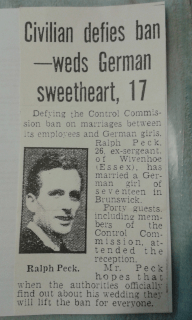
A few other couples married earlier, in secret, illegally, or without permission, such as Andrew Gardiner and Sabine Quast, and Ralph Peck and Ursula Ottow.

This post is written as my contribution to commemorate the seventy-fifth anniversary of VE Day, the end of the war, and the subsequent years of reconciliation between former enemies, peace and relative prosperity in Western Europe. It tries to answer the question: not who was the first, but how many British/German couples married in the first few years after the war?

On VE Day, 8 May 1945, there were around 750,000 British troops based in Germany, but the number declined rapidly as soldiers were demobilised and returned home. In June 1947 there were 114,000 British troops in Germany and only around 50,000 by March 1950. There were many more US troops in Germany, around 3 million in May 1945, falling to around 135,000 by June 1947. The number then remained stable until the end of 1950, when more US (and British) troops were posted to Germany, as tensions between the Western Allies and the Soviet Union rose following the start of the Korean War.

Despite many more US troops stationed in Germany in the first five years after the war, according to my estimates, there were roughly the same number of British/German marriages as US/German marriages; around 15,000 ‘war brides’ in both cases.

The number of ‘war brides’ and ‘fiancées’ entering the US was recorded in US immigration statistics, but not in the equivalent British figures. Before the British Nationality Act came into force at the start of 1949, the wife of a British man automatically acquired British citizenship on marriage, regardless of her previous nationality. This meant that if a couple married in Germany and subsequently travelled to Britain, no record was kept by the British immigration authorities. The wife was already a British citizen, with a British passport, and she had the right to enter and live in Britain, with no further questions asked. After the Act was passed, the wife had to apply for British citizenship, but this was very rarely refused. Provided citizenship was granted while the couple were still in Germany, before they travelled to Britain, she was treated as a British citizen, and no further questions were asked when she crossed the border into Britain.

Although there are therefore no immigration statistics on how many German women entered Britain as married wives of British men, we can estimate the number from another source. A government minister from the War Office stated in November 1951, in a written answer to a Parliamentary question asking ‘how many soldiers serving in Germany have married German women?

Since 1947, permission to marry a German woman had been given to 7,342 soldiers.

This figure of 7,342 serving soldiers granted permission to marry was most probably obtained from army records. I have not found any files in the archives with further information as to how this number was calculated, but as far as I know, the British Army of the Rhine (BAOR) was the only organisation that kept a record of serving soldiers granted permission to marry German ‘ex-enemy nationals’.

Some men married without permission. The minister added that since 1948 a further 305 soldiers were known to have married without permission.

Some British men may have been granted permission but never actually married, and some serving soldiers may have married in Britain rather than Germany, but not I think very many. Permission was only granted at the end of a long and complicated process and in all the cases I have researched, if the soldier was serving in Germany, the wedding took place, in Germany, very soon after permission was finally granted.

Statistics is not an exact science, but I think it is reasonable to say, based on the minister’s written answer to the question, that around 7,500 British soldiers serving in Germany either married German women, in Germany, or married without permission, between 1947 (when the first marriages took place) and November 1951, the date the question was asked.

Although married wives of British men entering Britain were not recorded in the immigration statistics, German women granted permission to travel to Britain to marry former soldiers who had now been demobbed, were recorded, as the women had not yet married and were therefore still German nationals when they entered Britain. The statistics recorded a total of 9,115 German nationals, quite a large number, admitted to Britain between 1946 and January 1951, in order ‘to marry British subjects’. 8,890 were women and 225 were men. (The men, by the way, were almost certainly German Prisoners of War who were returning to Britain to marry women they had met while they were held in Britain, but that is another story!)

The 8,890 German women recorded in the immigration statistics, who were admitted ‘to marry’ in Britain, were therefore in addition to the 7,342 serving British soldiers granted permission to marry in Germany. Not all the 8,890 women recorded in the immigration statistics who travelled to Britain may have actually married – some weddings may have been called off at the last minute, after the bride had arrived in Britain – but I would estimate no more than 1,000, at most. Permission to travel to Britain was not easy to obtain. Before being granted an entry permit, a German woman had to provide a signed letter in which her prospective husband promised he would marry her soon after her arrival, and confirmed that he could provide accommodation for the couple in Britain.

Add the figures together: 7,342 serving soldiers granted permission to marry German women in Germany, 305 soldiers who married without permission, and 8,890 German women recorded in the immigration statistics as admitted to Britain ‘to marry British subjects’, (16,547 in total); then take off around 1,000 to allow for the women who may have arrived in Britain, only to find there was no-one at the port to meet them, or their fiancé had called it off at the last minute, and I think it is reasonable to assume that a total of around 15,000 – 16,000 British/German couples married, in Germany and in Britain, in the first five years after the end of the war.

The historians Johannes-Dieter Steinert and Inge Weber-Newth have estimated, in my view incorrectly, that there were fewer, around 10,000 British/German marriages in the first five years after the war. I quoted this number of 10,000 in an earlier post on this subject in August 2016, but based on the immigration statistics and the answer to the Parliamentary question quoted in this post, together with my research into various individual cases, it seems to me that their figure of around 10,000 is almost certainly too low.

The number of British/German marriages may actually have been higher than the estimated figure of 15,000 – 16,000 given in this post, as the Parliamentary Question referred to ‘serving soldiers’ and may not have included sailors in the Navy; airmen in the RAF; or the many civilian British administrators in the Control Commission who married German women in Germany, (such as Ralph Peck and Ursula Ottow, or Jan Thexton and his wife Gunni).  In addition to these, around 8,000 British soldiers were demobilised overseas after the war, the majority in Germany and in India. According to Julius Isaac, writing in his 1954 book British Post-war Migration, they did so because: ‘In the case of Germany the motive was usually that British members of the Occupation Army married German girls or war widows and entered the business of the bride’s family’. How many there were of these, we don’t know. There were also 682 Austrian women admitted to Britain between 1946 and January 1951 ‘to marry British subjects’, and an unknown number of British men who married in Austria.

As is often the case, what the Americans did in Germany after the war has received far more attention from historians than what happened in the British Zone. In her study, GIs and Germans, Petra Goedde argued that more attention should be paid to the role of personal relations ‘hidden from the official documents of the political and diplomatic agencies’. In particular, she claimed that ‘the process of rehabilitation began before the emergence of the Cold War. It thus refutes one of the major assumptions of post-war German-American relations: that American policy toward Germany became conciliatory as a result of the Cold War. In fact … German-American rapprochement was as much a cause as a consequence of the Cold War.

My own research on ‘marriage with ex-enemy nationals’ – British men who married German women after the war – suggests that Petra Goedde was right. The process of reconciliation between former enemies is not something that happens from the top down, determined by government policies. It starts as ordinary people, such as those discussed in the posts on this blog, meet and get to know each other, as individuals, face to face.

References

Julius Isaac, British Post-War Migration (Cambridge: Cambridge University Press, 1954)

Petra Goedde, GIs and Germans: Culture, Gender, and Foreign Relations, 1945-1949 (New Haven & London: Yale University Press, 2003)

Susan Zeiger, Entangling Alliances: Foreign War Brides and American Soldiers in the Twentieth Century (New York and London: New York University Press, 2010)

My own research on the subject, with notes and references, has been published (in English) in a collection of papers given at an academic conference held in 2017 in Paderborn, Germany: Briten in Westfalen: Besatzer, Verbündete, Freunde? (Ferdinand Schöningh, 2019)

Marriage with ‘ex-enemy nationals’ (continued – part 8) – The first officially permitted marriage to take place in Britain, Anthony Blight and Liane Schlüter

4 May 2020

Who was the first British soldier or civilian member of the Control Commission to marry a German woman after the end of the Second World War?

Marriage with so-called ‘ex-enemy nationals’ was prohibited, before the government in London announced, on 31 July 1946, that the ban would be relaxed, subject to certain conditions. But it still took a long time for the couple to assemble all the necessary documents and as far as I can tell, no serving British soldier, sailor or airman was allowed to marry a German woman, in Germany, before March 1947, although as described in previous posts on this blog, a few couples married without official permission, such as Ralph Peck and Ursula Ottow, or in secret, such as Andrew Gardiner and Sabine Quast.

Some couples were able to marry earlier than March 1947 in Britain, rather than in Germany. Towards the end of 1946 – I don’t know exactly when – German women first received permission to travel to Britain to marry a British man they had met in Germany, who had now been demobilised from the armed services and had returned home. Travel to Britain ‘to marry’ was also subject to various conditions. Germans were not allowed to leave the British Zone of Germany without permission. There were no scheduled air flights, and travelling by road, rail and sea was not easy. Various documents had to be obtained, including a medical certificate, confirmation that the couple had somewhere to live in Britain, and a permit to leave Germany and enter Britain.

Renate Greenshields has described in her book, Lucky Girl Goodbye, how she was one of the first group of 15 German women who received official permission to travel from Cuxhaven in Germany on the ship, the Empire Halladale, on 18 December 1946, to marry in Britain. She and her husband, Tom, were married in Hawkchurch in Devon on 6 January 1947. And as described in another post on this blog, Ingrid Dixon has told the story in her book, The Bride’s Trunk, of how her parents first met in Germany, how they sent letters to each other after her father was demobbed and returned home, before he returned to Germany in December 1946 to collect her mother and travel with her to Britain. They were married in Liverpool a week after she arrived, on 13 December 1946.

But as far as I know, the first officially permitted marriage, in Britain, took place two months earlier. Kate Sherwood has sent me the following story of how her mother was able to leave Germany in September 1946, after hitching a lift on a cargo ship passing through the Kiel Canal, to marry her father on 19 October 1946, in Chiswick in London.

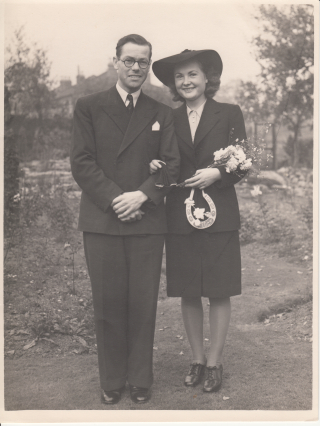
Liane and Tony Wedding photo

My mother, Liane Marie Schlüter, born November 1924, was living with her parents and younger siblings in Hassee, a suburb of Kiel, a town in Schleswig Holstein in the north of Germany, when she met my father. Two of her brothers had been killed in the war, Hugo aged 24 in Freiburg im Breisgau in early 1945, and Paul aged 18 in Küstrin/Kostryn around April 1945. 

She left school at 14 and completed an apprenticeship at the department store, Karstadt.  She then did war service as a land girl and as a conductress on the trams. Shortly after the end of the war she had the opportunity to start learning English.   

My father, Anthony George Blight, served as a gunner in the Royal Horse Artillery in North Africa, landed in Normandy and ended up outside Hamburg in May 1945. His unit was then sent to Kiel, where he stayed until he was demobbed in February 1946.

My father loved swimming and it was in an open-air swimming pool about a 20 minute walk from my mother’s home where they first met, maybe in the early summer of 45. Despite the non-fraternisation order (which apparently was disregarded by all and sundry), they went out for walks, spent time with her family, and visited her older sister and her husband in their apartment. 

So having fallen in love when marriages were still forbidden, and as my father had been demobbed and returned home to Britain in February 1946, they had to wait until Germans were permitted to travel to Britain to marry. Immediately this was announced, some time later in 1946, my mother went to the British administrators’ office in the Düppelstrasse in Kiel to request a visa. Having assembled all the required documentation, she then enquired as to how she could get to England and was told to buy an airline ticket or ask her fiancé to send her one. So she drafted a letter to my father indicating that she had all the documents necessary to travel, but needed an airline ticket, and asked the officer in charge to put his official stamp on it. My mother felt very uncomfortable about putting her fiancé to such an expense and perhaps realising this, the officer suggested he could instead arrange for her to travel by ship.

So, the letter was never sent, the officer accompanied her in an official car to the Kiel-Holtenau lock, where ships enter the Kiel canal on their way from the Baltic to the North Sea, and the naval officer in charge undertook to get her a safe passage. The only ship passing through that day bound for London was Russian, which was disregarded by the officer as being not suitable, so she returned early the following day. Eventually, a cargo ship carrying timber, presumably from one of the Baltic States, arrived and the Estonian captain agreed to take her. The ship’s crew included a female steward and my mother was given the first mate’s cabin and ate her meals with the captain and the engineer. She cannot remember how long she was on board but recalls wondering on arriving in London why the ship did not proceed to dock, to be told that the tide was against them. 

I don’t know how my father knew when she was arriving but he was at the docks with his brother to meet her on (we believe) Friday, 27 September 1946. A rather bemused immigration officer accompanied them on board, where he examined my mother’s entry permit. Presumably he would have stamped it so that we would have had a definite date of arrival but it has not survived. My father and uncle gratefully accepted the invitation to eat breakfast, just then being served. My father enquired as to how much he owed for my mother’s passage to which the answer was “This is not a passenger ship, there is nothing to pay”.

They were married on 19 October 1946 in Chiswick Register Office and until I was born, in September 1947, they lived with my grandparents in Whitton, Middlesex. 

Kate Sherwood, May 2020.


Marriage with ‘ex-enemy nationals’ (continued – part 7) – Henry Galley and Therese Siemensen

27 April 2020

Previous posts on this subject have told the stories of British soldiers and civilian members of the Control Commission who met and married their future wives in occupied Germany soon after the end of the Second World War.

Not all stories ended happily. In some cases the marriage was called off at the last minute. Very few records have survived when this happened – it was not something most people wanted to remember or talk about – but there is one interesting case in the documents collection of the Imperial War Museum.

This post is based on the private papers of Henry Galley, donated to the Museum by his son. The papers comprise seventeen letters written by his intended bride, Therese Siemensen, together with a few official documents including British Army form 120, requesting permission to marry; and a few postcards and photographs, including two passport-sized photos of Therese (‘Terry’), on the back of one of which she wrote ‘All meine Liebe für dich mein Harry’ [All my love for you, my Harry] and on the other ‘Deine Terry’ [your Terry].

According to the official documents, Henry Galley was a corporal in the Royal Engineers, born in Barnsley, Yorkshire, in March 1921. Therese was slightly older, born in May 1920 in Mantau, in the Czech Sudetenland [in Czech, Mantov, a small village near Plzen]. Certificates of good character from the Police and the local Catholic parish office confirmed that she was now living in Neumünster, a small town in Schleswig Holstein, in the north of Germany, a long way from Mantau, and was working as a seamstress. She was a widow, her maiden name was Blahout, and she had lived in Neumünster since February 1945, a few months before the end of the war.

We don’t know when she first married, what had happened to her husband (though we can guess that he may have been killed in the war), or why she had moved to Neumünster. The parish office added a somewhat ambiguous note to the certificate, stating that they could not provide any further details (so presumably she was not a regular attendee at the church) but they were not aware of anything unfavourable (‘Nachteiliges ist uns nicht bekannt’).

The form requesting permission to marry was dated 3 November 1946, and gave the expected date of marriage as 1 July 1947.

The first letter in the file from Therese is dated 8 September 1946, written from Dornstadt near Ulm in the south of Germany, where she was staying with her sister and then with her mother. On 26 November she was back in Neumünster, writing that she had learnt from the British barracks that Henry was now in Hamburg. The letters were handwritten in German all in capitals. She clearly spoke very little English and he understood very little German. She wrote the following day that a letter she had received from him (presumably in English) had been translated for her. In her letters she wrote that she loved and missed him, that he need not worry about her remaining true to him, and she asked him what she should do about the papers needed to obtain permission to marry. She also gave her best wishes to his parents.

Her next letter, dated 11 December 1946, was not written in German, but translated into English and typed. She wrote that she had received his letter the previous day. She was glad that he was now home (in Britain) and would ‘put all matters regarding our wedding through the right channels’. She had been to the health office for an examination; she was surprised that his parents were not opposed to their marriage; and she was going to take English lessons after Christmas.

They continued to write to each other, and on 3 February 1947, she sent another typed and translated letter, thanking him for his two letters. We now learn that she had a child from her first marriage, as she wrote that ‘my only worries are about Edda, although I know that she is in good hands no matter how long I should be unable to take her to me. But I do wish to be able in 1-2 years’ time to take the child again, lest it becomes totally estranged. Harry, please, do write to me on this matter, so I may be able to inform my sister about this.’

It seems that her daughter Edda was staying with her sister, as following further letters telling him that she was concerned that she had not heard from him, and that she expected to receive her visa to permit her to travel to England within the next six weeks, she wrote to him on 20 April from Dornstadt, where she was staying with her sister. She told him that she was going with her daughter, Edda, to stay with her mother for three weeks, and her sister had said that Edda could then stay with her, until Therese had her own home and could come and fetch her.

A few weeks later, on 3 June 1947, Therese sent Henry another typed and translated letter. She told him that she now had her passport and could come to England any time, adding ‘you will be advised by the British Red Cross organisation about the exact date of my arrival’. She asked him if she could come in July, and the letter ended: ‘I am so happy that the time has arrived for you and me to be together again. This time of waiting was very hard for me, but it has been overcome now.’

He must have called it off, as there is only one more letter in the file, dated 24 April 1948, ten months later, written in German, and sent from Uffenheim, also in the south of Germany, but quite a long way, around 150km, from Dornstadt. She wrote that he was perhaps surprised that she should write again after such a long time. Her thoughts were still with him. She had a hard life in the past few months but now ‘Gott sei Dank habe ich diesen Kampf überstanden’ [Thank God, I have survived this fight]. She was living in a small village with her mother and ‘es geht mir gut’ [things were OK]. She was working again as a seamstress. She hoped all was well with him and she wished him well. Finally, she wrote that, if he had not forgotten her, perhaps he could write to her again. ‘So will ich für Heute meinen Brief beenden mit den besten Grüssen und immer an dich denkend, deine Therry Siemensen.’ [I will end my letter for today with my best wishes and always thinking of you, your Therry Siemensen].

There is nothing in the file to explain why he called it off, except a receipt dated 19 May 1947 from the Quaker ‘Friends Committee for Refugees and Aliens’, confirming that they had received a sum of money, eight pounds, two shillings and sixpence (£8.2.6), from Mr Henry Galley, as a ‘deposit for Miss Therese Siemensen’. This was quite a large sum at the time, more than a week’s wages. Presumably the money was so that the Friends Committee could help her travel to Britain.

This must have been when he finally decided not to go ahead with the marriage. Soon after sending the money, most probably before, but just possibly on the day he received Therese’s letter of 3 June telling him that she had her passport and could travel any time, (her letter would have taken a day or two to arrive), he wrote to the Friends Committee asking for his deposit back. He received a reply, dated 5 June 1947, acknowledging receipt of his letter and, as requested, returning his deposit of £8.2.6 (less 2/6 for office expenses).

This is all we know of the story, based on her letters and the documents in the file. We don’t know if he wrote to tell her not to come, but it is not surprising that he called it off: a widowed German woman, slightly older than he was, with a young child, who hardly spoke any English. They would not have had an easy life together. What I find intriguing is that he kept her letters, wondering perhaps ‘what might have been’, until he died.

References

Therese Siemensen letters to Henry Galley, 1946-1948, Imperial War Museum documents, reference 26278


Marriage with ‘ex-enemy nationals’ (continued – part 6) – Andrew Gardiner and Sabine Quast

20 April 2020

Since my first post on the subject of marriages with ‘ex-enemy nationals’ on 2 May 2009, I have been trying to discover who was the first British soldier or civilian member of the Control Commission to marry a German woman after the Second World War, and when the first wedding took place.

As previous posts on the subject have shown, it is not an easy question to answer. It depends, among other things, on whether the wedding took place in Britain or in Germany, whether the couple had received permission to marry from the British authorities in Germany, and what actually constituted a legally valid marriage, according to British and German law.

Marriages with so-called ‘ex-enemy nationals’ were officially prohibited during and after the war, before the government in London announced on 31 July 1946, that the ban would be relaxed and British men would be allowed to marry German women, subject to certain conditions. Even after the ban was relaxed, marriages were strongly discouraged and numerous conditions had to be met before a couple was granted official permission to marry.

Andrew Gardiner and his wife, Sabine Quast, were married by a British Army Padre on 6 October 1945, which is earlier than any of the couples I have written about previously, but they kept their marriage secret from the army authorities, (though not from his family). As there were no witnesses present, apart from the Padre, I’m not sure if the wedding was strictly valid according to either British or German law. They held a second ceremony in July 1947, conducted by another British Army Padre, and a third ceremony soon afterwards at a German registry office (Standesamt), to ensure that the marriage was legally fully valid.

This post is based on an unpublished memoir that Mr Gardiner wrote for his children, now held as part of the documents collection of the Imperial War Museum.

Andrew Stevenson Gardiner was born to a relatively affluent, middle class, Scottish Lowlands family. He attended a prestigious private school, the Edinburgh Academy, and joined the Officer Training Corps (OTC) when he was ten years old. He was called up to the army in late 1941, identified as a potential officer, but rejected for officer training on the grounds that, according to his memoir, he was considered to be ‘too individualistic and immature, needs broader experience’.

He was posted in 1943 to the Lothians and Borders (L&B) Horse, a Scottish Yeomanry regiment, took part in the Normandy Landings as gunner on a flail tank, and then fought in France and Holland. At the end of the war in Europe in May 1945, he was in Holland near the border with Germany. He wrote in his memoir that some of the British troops crossed the border: ‘to pick up, or put more bluntly, to loot; watches and cameras being the prime targets’.

After advancing across the British Zone of occupation to Blankenburg, on the border with the Soviet Zone, he volunteered for the Regimental Police, and was transferred to the district of Isenhagen-Hankensbüttel, in Lower Saxony, which he described as ‘a most attractive region of open birch and pine woodland dotted with villages and small towns’. Their duties were to ‘keep the peace’ and guard the regimental HQ.

Their ‘main headache’, he wrote, was the large number of Displaced Persons (DPs), in the area, mostly Polish. ‘Some of the more active … understandably of course, carried out raids on their former conquerors’ properties such as farms and grocery stores for such items as potatoes and sugar in order to brew schnapps.’

Despite claiming that: ‘Most often these were armed raids and we were forced to act accordingly’, he wrote that there were only two serious raids by DPs in his area, one on an isolated farmhouse and one on a grocery store. They successfully caught both groups of raiders, and neither made any attempt to use firearms.

On the day they first moved into their new HQ in Hankensbüttel, a German family was also moving in to the house immediately opposite. The activities of their new neighbours, the British soldiers, ‘caught the amused attention of two attractive young ladies in this family. Within a few days, this attention grew into exchanges of friendly waves from both sides and eventually into closer contact.’

He discovered that one of the ‘attractive young ladies’, Sabine, ‘spoke perfect English’ and the British troops were able to employ her as an interpreter. ‘Her parents, anxious no doubt, that nothing irregular should occur between us, very sensibly began to invite me (and a colleague) into their home … to meet the family on a more formal basis.’

Sabine’s family were refugees who had fled from Schneidemühl in the East of Germany (now Piła in Poland) towards the end of 1944. Her father was a civil engineer who had owned two firms engaged on railway work. Without warning, he was suddenly arrested in Hankensbüttel by two RAF sergeants from the British Field Security Police. It later emerged, Andrew wrote in his memoir, that her father had been denounced as an ardent Nazi, but he was released many months later on the testimony of two Polish drivers who still worked for the family.

After her father was arrested, Andrew’s contacts with the family ‘strengthened’ and ‘A close mutual trust grew between Sabine’s mother and myself; she often claimed afterward that, my cheerful presence helped keep her going in this dark period.’

It also began to dawn on her … that, Sabine, by now “Bibi”, and I had fallen deeply in love.’

Andrew returned home for a period of leave, during which his friends and their parents ‘would place various temptresses in my way if we were going out to the cinema or to a social function…. But to no avail. My heart was in Hankensbüttel.’

Soon after his return to Germany, the German Bürgermeister (mayor) of Hankensbüttel, who was a regular visitor to the British Police headquarters, remarked that he was delighted to see how well Andrew was getting on with Sabine’s family, adding that if he ‘ever wished to marry Sabine, he would be honoured to conduct the ceremony.’

My inner reaction was that of a blind man, who is suddenly given the blessing of sight. Until that moment, this idea had not entered my head, but once implanted it quickly took a firm hold of my imagination. Nevertheless, with the ban still operative, some weeks were to pass before this idea was translated into any form of action.’

The ‘catalyst’ was an article on the front page of the Daily Express which stated that despite the ban, ‘a number of soldiers were persuading Roman Catholic priests to conduct the ceremonies in secret.’ If the Bürgermeister’s offer had‘sown the seed’, the article in the Daily Expressprovided the germinative medium’.

Almost from the moment the paper was put down, I was committed … It may be an exaggeration to suggest a personality change, but from then on and in the months that followed, I was able to tap depths of energy and may it be said “courage” of which, until then, I was unaware.’

They wanted to ‘tie the knot’ before his unit was moved elsewhere in Germany. ‘We wished more than anything to feel that we were man and wife no matter where I was posted in the future … In a physical sense, also, marriage would prevent any improprieties.’ But he was also concerned about breaking a family tradition of marrying within the Scottish Lowlands; ‘something taken for granted as the natural order of things; an almost sacrosanct concept … which I had begun to question soon after entering the Army.’

His first attempt to marry Bibi ‘followed the path’ outlined in the Daily Express article. The two of them set off in a pony and trap with a driver, all of which had been hired from a local farmer. They found the Priest, who turned out to also have come from Schneidemühl, but he told them he ‘dare not comply with our request’.

The next day Andrew spoke to the Bürgermeister, who was equally sorry. The Army, perhaps prompted by the Daily Express article, had issued instructions that all German officials were now strictly forbidden to conduct civil marriages between British service personnel and German nationals.

He called on the regimental padre, David Orr, who ‘listened carefully, pointed out the problems we would have to face, but was gradually won round, perhaps by my earnestness, and agreed to conduct a simple ceremony on our behalf. There would be no witnesses and no immediate advantage could be taken of the situation.’ The marriage had to remain secret. ‘I gave him my word’. But Andrew did tell two of his colleagues and friends.

On Saturday 6 October, 1945, at 7.30 in the evening, Andrew and Bibi ‘walked to the Padre’s quarters, aptly labeled with twin sign boards “Church House” and there he tied the knot for us in a short ceremony.’ Afterwards they held a ‘modest celebration’ with a few friends.

The ‘personal storm’ was not long in breaking. ‘On sending the news home to Edinburgh, I received no reply; only a summons from the new Commanding Officer who had received a solicitor’s letter, on behalf of my father, demanding an explanation.’

Fortunately, his Commanding Officer did not take the matter further, apart from telling him that if anything alleged in the letter was true, he would be posted overseas. Andrew did not ‘give anything away directly’ and the matter was apparently forgotten, though his relations with his family at home remained ‘very strained’.

His unit was posted away from Hankensbüttel. He was transferred to another regiment, the Royal Scots Greys, again joining the Regimental Police. Bibi visited him occasionally and he ‘was able to slip off at various times for short visits to Hankensbüttel, before our marriage was recognized as legal in July 1947.’

I use the word legal reservedly, because it was necessary to go through a second ceremony, but the garrison Padre very kindly modified the text to take account of the first. Also, to make completely certain that our marriage was recognized by the German authorities, we went through a third ceremony in the local Registry Office. Thus we were well and truly tied.’

Andrew and Bibi moved to Lüneburg. Perhaps because he was reluctant to return home, he put off his demobilisation by 18 months and signed on as a regular soldier in the army. He was offered a commission, but declined. They travelled to Scotland and eventually made peace with his parents. He purchased his discharge at a cost of £100 and left the army in August 1948.

References:

Private papers of Andrew S. Gardiner, typewritten manuscript, A Romantic with the Yeomanry: being an account of my Army Service, 1941 to 1948. Imperial War Museum documents, reference 402.


Marriage with ‘ex-enemy nationals’ (continued – part 5) – William Clark and Paula Koll

14 April 2020

Here is another post on the theme of British soldiers and civilian members of the Control Commission who met and married their future wives in occupied Germany after the end of the Second World War.

William Clark and his wife Paula were married in Hamburg on 1 August 1947; not as early as some of the other couples I have written about on previous posts on this blog, but I think it is an interesting story, that tells us something about life in post-war Britain in the 1950s as well as in occupied Germany in the first few years after the end of the war.

The post is based on an unpublished memoir written by Mr Clark, now held as part of the documents collection of the Imperial War Museum.

William Clark was born in 1926 in Birkenhead. He enlisted in the army towards the end of the war, when he was just 17 years and 10 months old. He trained as a radio operator, took part in the Normandy landings, and in May 1945 at the end of the war in Europe, he was in Kiel in Schleswig Holstein, in the north of Germany. He remembered that:

‘The feelings of relief and happiness that we all felt [at the end of the war] were greater than it is possible to express. We could relax, and have a bit of fun.’

He did not stay long in Kiel, and was posted to Berlin where his unit had to clean the barracks previously used by Soviet soldiers, now taken over by the British, ‘a most unpleasant job’.

On a trip home for leave on a long train journey from Berlin, he wrote that he saw German civilians gathering along the line holding out their hands, hoping that the British soldiers on the train would throw unwanted food to them: ‘It was a pitiful sight, whether they had been at war with us or not, they were starving, and it was impossible not to feel extreme sorrow that people had been reduced to that kind of begging.’

Shortly before the end of the war, on the way to Kiel, his unit drove through a small village in Schleswig Holstein called Horst. This was when he first saw his future wife, Paula. He wrote that: ‘I could not help noticing a German girl coming down the steps of a building near the side walk opposite me. I thought she was pretty, and wishing to convey that thought, I gave what was then known as a “Wolf” whistle. The girl obviously took offence and indicated so by spitting on the sidewalk while saying “Ach schmutzig Tommy” [dirty Tommy] … I remember thinking that she was not afraid to show that we were the enemy, and that friendliness was not in order at that time. I quite admired her courage; there were a lot of us and only one of her.’

They ‘pushed on’ and he thought no more about it. But some months later – it is not clear quite how long – he was posted, by chance, to Horst, the same village where he had seen the girl earlier. ‘After settling in at the village of Horst, my first thoughts were to try to locate the girl. The village was quite small, and it remains so to the present, so I didn’t think I would have too much difficulty.’

His unit took possession of houses down one side of the village street and a curfew was imposed on all civilians. During one of his turns on patrol, he saw the girl and ‘made a mental note of her address. Many walks past her house paid off, as I finally got to talk to her. Just by speaking to her I was breaking the law, because we were not supposed to fraternize with German civilians. However, being nineteen and smitten, all rules were made to be brokenAfter a while I was made welcome into her home, and passed many happy hours with her family.’

Four of Paula’s brothers had been soldiers on the Russian front. Two had been killed and two were Russian POWs. He wrote that: ‘It says much for the compassion the parents had, while having been so affected by the war and having lost two sons, they still made me, an enemy soldier, welcome in their house.’

His unit moved again, to Wilhelmshaven, not very far away. He travelled to Horst when he could, by jeep, motorcycle or train. ‘We were not supposed to use civilian trains, but a little bribery with cigarettes worked well.’

I can’t remember when I asked Paula to marry me, but in order to do so I had to get the permission of the commanding officer.’ He was told he had to spend at least one period of leave in England. ‘The purpose of this was to enable the parents to talk their son out of marrying one of the enemy!

As he did not want his parents to talk him out of it, he decided not to go home on leave. He wrote to his mother that she should tell anyone who asked, that he had been home. The army checked up on him and his mother told them the truth, that she had not seen him. His application to marry was refused and the army ‘postponed the chance of marrying until I could re-apply in a further nine months’.

I thought the world had come to an end, a fact made worse a while later, by Paula finding she was pregnant. I was even angrier at the army, but there was nothing I could do. Her parents were very understanding, and while not pleased with the circumstances, continued to treat me kindly.’

He returned to England and his reception there ‘left much to be desired. They were all still very bitter about the Germans, and the idea that I wanted to marry one was met with a lot of disapproval.’

He felt lonely as he spent the time buying things for the baby. He cut short his leave and returned to Germany, adding that: ‘It was the first time that I was glad my leave was over. I felt more at home in Germany than I did in England.’

His daughter Helen was born in Horst on 8 December 1946. He was still stationed at Wilhelmshaven and a week later was able to see his daughter for the first time.

He continued to try to get permission to marry. By the time it was granted his unit had moved to Münster, nearly 200 miles away. ‘Making wedding arrangements was extremely difficult, various regulations had to be met, an army padre had to be found, and a church suitable to him and us had to be arranged. Transportation presented yet another difficulty. German civilians were not supposed to ride in army vehicles. [This was officially forbidden at the time]. How to get Paula and the family and other relatives to and from the church was going to be difficult, and required another law to be broken. The irony was, that after the wedding, Paula would be a UK citizen and entitled to travel in the military vehicles.’

After further delays due to unavailability of an army padre, they were married In Hamburg on 1 August 1947. He returned to Münster and she to Horst.

They remained in Germany until 1948, when he was posted back to Britain. He had 6 months to serve before demobilization. Paula, his daughter Helen, together with other German wives and children, had to move to a transit camp awaiting clearance to enter England. [This is the first reference I have found in any archive to a ‘transit camp’ for German wives of British soldiers who had been posted back to Britain].

After a brief period living with his parents, they moved to Parkgate, a village in the Wirral not far from Birkenhead. Paula was expecting another baby. He worked as a milkman, and then found another job on the railway at a nearby station, that paid £3 per week, barely enough to cover the rent, which was £2 per week.

Things being quite tough in those days, the thought that I was responsible for taking a young girl from a comfortable home to a strange land, with the lack of money and other discomforts, was hard to bear. We tried hard not to allow the children to suffer, and I think we succeeded, in spite of having to eat porridge as a main meal! Although it does look terrible in the written word, we were quite happy really.’

They needed more money so he changed jobs again to work driving a delivery van. ‘Our family continued to grow. Paula’s English improved greatly, and both she and the kids made many friends.’ People were friendly in Parkgate. He got a better paid job at the Atomic Energy Plant at Capenhurst, 11 miles away, but left after 3 years, disappointed at not getting a promotion. They moved to Harlow in Essex which, he wrote, was a mistake. The work was bad, inspecting glass jam jars and bottles as they came out of the oven.

He visited an officer he had known during the war, who lent him the money to buy a delivery vehicle, to do door to door vegetable deliveries.

Towards the end of 1954 or early 1955, he became ill, had to go into hospital, and the finance company re-possessed his delivery van. Paula got a job in a local factory. He found a job installing TV aerials. Things started to improve, he was given a store manager job, but gave it up and decided to emigrate to Canada, initially on his own. By May 1958 he had saved enough to pay the fares, so Paula and the children could join him in Canada. He obtained a good job with an established company where he worked for 18 years.

They then discovered that Paula had cancer and she died aged 38. He met his second wife and a ‘second life’ began. At the end of the memoir he wrote: ‘While having wonderful memories of those years, I also have many regrets. Sadness at realizing too late that I was often impatient with, and perhaps unkind to, a great person.’


References: 

Private papers of William Clark, Imperial War Museum documents, reference 26005

Marriage with ‘ex-enemy nationals’ (continued – part 4) – Ralph Peck and Ursula Ottow

6 April 2020

Who was the first serving British soldier or civilian member of the Control Commission to marry a German woman after the end of the Second World War? I first asked this question in May 2009 in a post on this blog on Marriage with ‘ex-enemy nationals’, with two updates, on May 2013 and August 2016.

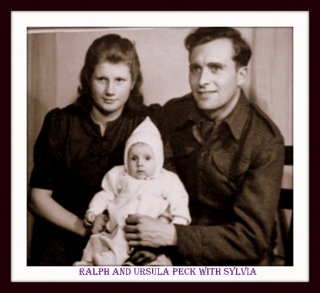
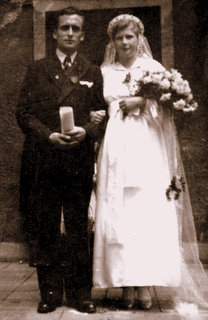
I have continued to research the subject over the past few years, and this post tells the story of Ralph Peck and his German bride, Ursula Ottow, who were married in the St Johannes church in Brunswick on 20 August 1946, earlier than any of the couples I have written about previously, or whose sons or daughters have added comments to earlier posts.

Ralph and Ursula  wedding photo

But Ralph and Ursula married without permission from the British authorities, and they did not realise that their church ceremony was not valid in German law, according to which church marriages must be confirmed in a civil registry office (Standesamt) before they are legally valid.

They were eventually officially married in the Standesamt in Goslar on 21 May 1947, nine months after their church wedding on 20 August 1946.

An extraordinary collection of documents preserved by Ralph’s son, Clive, which he has now donated to the Imperial War Museum, shows that even after the British government announced, on 31 July 1946, that the marriage ban with ‘ex-enemy nationals’ would be relaxed, it was still enormously difficult, time-consuming and stressful for a couple who wished to marry to understand the regulations, obtain all the necessary documents and finally receive permission to marry, in full accordance with British and German law.  

Ralph first met his future wife, Ursula, soon after the end of the war, and they decided to marry in December 1945, when British men serving in the armed forces or Control Commission for Germany (CCG) were still forbidden to marry ‘ex-enemy nationals’.

Ralph was born on 5 November 1919 and served during the war in the Royal Corps of Signals. According to his Soldier’s Service Book, he enlisted on 8 July 1940 and was employed as a clerk. He was promoted sergeant, awarded the Africa Star, was entitled to the Defence Medal, and served overseas, mainly in the Middle East, for a total of 5 years and 14 days. At the end of the war in Europe, in May 1945, he was in Germany, stationed in Brunswick, in the British zone of occupation.

Ursula was born on 15 April 1929 in Flatow in West Prussia, now Zlotow in Poland. Like many other Germans, she had fled westwards with her family ahead of the advancing Soviet troops.

The documents do not reveal when or how they met, but Ursula told her son Clive that it was soon after the end of the war, at a dance hall, and Ralph asked her to marry him the first time they met. She was only 16 years old at the time.

On 2 January 1946, Ralph wrote a letter, in German, to Ursula’s parents, asking for their consent to the marriage. Ursula’s parents now lived in Oschersleben, not far from Brunswick, where Ralph was stationed – but Oschersleben was in the Russian Zone of occupation. Travel between the Russian and British zones was difficult and required special permission, so they could not meet face to face. Ralph wrote that he hoped to meet them soon. As he was due to be demobilised and return to Britain in April and as he loved their daughter, he asked for their permission to marry and take Ursula with him to England. He added that he and Ursula would return to visit her parents every year, and would spend the next Christmas with them in Germany.

Ursula’s father, Alwin Ottow, replied to Ralph on 22 January 1946. He wrote that he and his wife were glad to hear that their daughter Ursula had met someone willing to make her his wife and this would, he added, help create a bridge of friendship between the British and German peoples. He welcomed the news and had no objections, but felt he had to express some concerns. Ursula was very young and inexperienced. She would be only 17 years old in April. She had no job, had not trained for any career, and had no possessions apart from the clothes she was dressed in. He also questioned how she would cope with leaving home and living in a strange and unfamiliar country. But, he added, the decision was theirs alone. At the end of the letter he asked for the wedding to take place in Germany, rather than in England, so that he and his wife could be present.

The couple announced their engagement on 5 February 1946.

On 18 March 1946, Ralph applied to the army authorities for permission to marry. He received a reply on 23 March 1946 refusing his request on the grounds that army regulations did not allow marriage with German women who had lived in Germany during the war.

Refused permission to marry by the army, Ralph thought that he could still marry Ursula after he was demobilised, if he returned to Germany as a civilian. He wrote on 27 March 1946 to the Home Office, Aliens Department, in London, that he wished to marry, as a civilian, a ‘young German girl’. He was due to be demobilised between 20 April and 17 May and intended to ‘seek immediate permission to return to Germany for the purpose of marrying the girl and returning with her to England’. He asked to be notified of the correct procedure to be adopted, adding that parental consent had been given for the marriage. If possible, he wished to arrange the marriage before his departure to England.

Around the same time, at the end of March, he applied to join the civilian Control Commission for Germany (CCG).

Ralph’s application was successful. He started work with the CCG and returned to Germany in July 1946, stationed initially in Brunswick and then at Goslar. On 22 July he wrote to the CCG Welfare Office in Lübbecke, a small town in Westphalia, stating that he was submitting his application ‘to marry a German girl’, adding that he had originally applied on 18 March 1946 while serving as a Sergeant in the Royal Corps of Signals, and the matter was not passed to higher authority then as ‘it was considered that there would be no possibility … of approval being given.’

He now asked if permission could be given at an early date, as he had returned to Germany as a civilian. If this was not possible, he asked if he could escort his intended bride home while on leave ‘where a home awaits her, where her arrival is eagerly awaited and her presence amongst my family would be that of genuine welcome’. He would then return to his job in Germany until a change of policy allowed German wives of Control Commission personnel to live in Germany.

Ralph received a reply dated 6 August 1946 from the CCG Civil Establishment Office refusing his request to marry, on the grounds that: ‘the position stated in C.E.O. Circular no. 36L of 14.12.1945 remains unaltered, and consent to marriage between civilian personnel of the Commission and Germans is in all cases refused.’

This reply is surprising as only a few days earlier, on 31 July 1946, the government had officially announced in London that the marriage ban would be relaxed. Presumably the news had not yet reached the British officials in Germany.

Despite not having received official permission, Ralph and Ursula decided to go ahead anyway, and were married in a church ceremony in the St Johannes Church in Brunswick on 20 August 1946.

But that was not the end of the story.

Trauschein

Ralph almost certainly did not know that when he and Ursula were married in church on 20 August, in Germany, unlike England, church marriages were only legally binding if they were confirmed at a government registry office (Standesamt). This had implications in Britain as well. According to British law, properly conducted marriages in foreign countries were accepted and recognised. But if a church marriage was not legally binding in Germany, it was not legally binding in Britain.

The documents in the files show that between the end of August 1946, after he was married in church, and May 1947, when the registry office marriage finally took place, Ralph desperately tried to find out what was the correct procedure, obtain the required documents, and meet the various conditions to be fulfilled, before he and Ursula were eventually married in full accordance with German and British law.

2016-11-25 17.29.04The church marriage was reported in the newspaper, the Daily Mirror, with a photo of Ralph under the headline: ‘Civilian defies ban – weds German sweetheart, 17.’ The text of the article ran: ‘Defying the Control Commission ban on marriages between its employees and German girls, Ralph Peck, 26, ex-sergeant, of Wivenhoe (Essex) has married a German girl of 17 in Brunswick. Forty guests including members of the Control Commission attended the reception. Mr Peck hopes that when the authorities officially find out about his wedding, they will lift the ban for everyone.’

It is interesting that according to the article, ‘members of the Control Commission’ attended the wedding and seem to have had no objections to it, despite the wedding taking place without official permission. But it is not known who were the guests at the reception, or how the Daily Mirror heard about the wedding.

On 4 September 1946 Ralph wrote to the London office of the Control Commission asking to be advised of the ‘correct procedure to be followed, in respect of marriages taking place between Control Commission personnel and German subjects, adding that ‘I have been unable to obtain any definite instructions of the correct procedure to follow regarding this matter, although I understand, notification as far as military personnel are concerned, has already been issued by army authorities.’

This suggests that by now, Ralph probably knew that the government in London had decided to relax the marriage ban. On 31 July 1946, a government spokesman had made a statement in the House of Lords that ‘local military Commanders should be authorised to relax the present ban on marriage between British servicemen and alien women … in cases where the reasons for marriage are good and there is no security objection.’

But although the decision in principle had been taken to end the marriage ban, it took many months until it was implemented in practice by the various military and Control Commission units in Germany. Ralph received a reply to his letter of 4 September from the Director of Organisation, Zonal Executive Offices in Lübbecke, dated 18 September, stating that marriages were not yet possible but the situation was ‘under active consideration’ and a general announcement would be made as soon as a decision had been made.

Ursula was now pregnant, and their daughter, Sylvia Lilian Gabriele was born on 22 November 1946.

Ralph  Ursula and Sylvia

Ralph may have first become aware that his German church marriage was not legally binding when he attempted to register his daughter’s birth.

He wrote on 17 December 1946 to the Civil Establishment Office for the CCG in Lübbecke and to the Passport Control Office in Berlin, asking for permission to ‘sign the Register’ at the Standesamt in Goslar in order to ‘complete my marriage’ adding that: ‘At present I am unable to obtain a “proper” birth certificate for my child and I have signed a certificate to the effect that ‘I am the father of my child’ pending authority requested above.’ He continued: ‘I wondered whether I could overcome the terrible strain and worry, which I have undergone for some very considerable time’.

He received a reply stating that conditions were still being formulated and he should wait until a general announcement was made.

On 1 February 1947, he wrote in desperation to his MP, Sir Stanley Holmes, asking for help. In the letter, he wrote that shortly after arriving in Germany, he ‘met and fell in love with a German girl’. He had applied to marry on 18 March 1946 but this was rejected on the grounds that the girl lived in Germany during the war. After enclosing details of further letters and copies of official instructions he added that: ‘So far [despite] all my repeated attempts to complete my marriage and return with my young wife and daughter to the UK, I remain where I commenced with my endeavours several months ago … You will fully imagine how difficult my present position is and, if it was not for the kindness shown to us by the wives of other English officials over here, I have grave doubts how I could have kept my wife and child sailing through these last damnable months.’

He received a reply on 8 February from Sir Stanley Holmes’ agent, saying that the MP was ‘abroad on an important business mission in connection with the export drive’ but the issue was being investigated and he would write to him again. It is not known if Ralph received a further reply, as there is no more correspondence from the MP in the archive.

The procedure to be followed by Control Commission staff wishing to marry German women was officially confirmed by Ralph’s military government unit in Germany in March 1947.

A daily routine order was issued by HQ R.B. Brunswick, on 28 March 1947, stating that marriages between ‘British subjects and persons of enemy or ex-enemy nationality or birth’ were now possible, adding that CCG employees who married without permission would be obliged to resign or be liable to dismissal from the CCG. The order continued by outlining the procedure that staff should follow if they wished to marry Germans and ‘retain their appointments in C.C.G.’ as follows:

  • Approval would not be given until six months after the date of the first application. After completing the required procedure, marriages could take place in a German registry office and ‘this marriage will be valid under German and U.K. laws’.
  • Applicants had to apply on form B.A.O.R. 120 for permission from their chief of division, supported by certificate of good character of the prospective bride, signed by the local German rgermeister (mayor) together with a certificate from a local Minister of Religion and two copies of the ‘Fragebogen’ (a questionnaire used to identify those who had been members of or had supported the Nazi Party).
  • Once official approval had been given by the British commander, an application had to be made to a senior German legal official, the ‘Oberlandsgerichtspräsident’, for a certificate that the British man was eligible to marry. (This was a requirement of German, rather than British law). The certificate should then be forwarded to the HQ of the appropriate British military government region.
  • Applicants might then be requested to attend in person before the British Consul General in Hamburg to complete the formalities of the Foreign Marriages Act 1906, (to confirm that the marriage was valid under British law). 
  • Once married, the couple had to live in officially requisitioned accommodation, which would be made available under the same conditions as for British families. Under existing rules, they were not permitted to live with the wife’s family or in other German accommodation, although this was being reviewed.
  • After taking up married quarters the wife would be treated in exactly the same way as a British-born wife, as regards entitlement to rations, travel etc.
  • No exception to the conditions would be made ‘on account of pregnancy or when a form of marriage has already taken place’.
  • Applications made previously should be made again, following the above procedures, but would be deemed to have been submitted at the date of the original application or 10 September 1946, (six months before the date of this order outlining the procedure) whichever was the later.

Ralph and Ursula were finally legally married two months later in a German registry office (Standesamt), on 21 May 1947, after he had obtained permission from a senior commanding officer, and had submitted certificates of health and good character for Ursula, signed by the Bürgermeister (mayor) and a minister of religion, a certificate of good health and freedom from disease signed by a doctor, together with four copies of a Fragebogen completed and submitted for security clearance.  The file is full of letters, memos, and certificates that had to be provided before the wedding could take place, as Ralph tried to work out the best way to ‘complete’ his marriage as quickly as possible and meet the various requirements outlined above.

Unfortunately, this story does not have a happy ending.

Their little girl, Sylvia Lilian Gabriele, lived for less than one year. She died in the children’s hospital in Bad Harzburg, near Goslar, on 30 June 1947, less than six weeks after they were legally married.

Ralph resigned from the Control Commission after a year’s service and his appointment was terminated on 19 July 1947.

He and Ursula travelled together to England and lived with his parents in Essex. Their first son, Clive, was born in April 1948 and a daughter two years later.

Ralph was not happy back in Britain. He joined the New Zealand air force, and Ursula joined him with their two children in New Zealand in 1952. But after arriving, Ursula fell ill with TB and could no longer look after the children. The marriage split up. Ralph returned to England with custody of the children. He remarried and died in 1997. Ursula remained in New Zealand.

On a happier note, nearly seventy years later (in December 2016 when the documents were donated to the Imperial War Museum) Ralph and Ursula’s son Clive was still in touch with his mother in New Zealand and with his father’s family.


References

R.G. Peck papers, Imperial War Museum documents, reference 26388.

Some of the most significant documents in the collection are listed below in chronological order:

  • 2 January 1946. Typed letter to ‘Herr und Frau Ottow’, signed ‘Ralph’, asking for their consent to the marriage.
  • 22 January 1946. Handwritten reply addressed to ‘Sehr geehrter Peck’, signed A. Ottow.
  • 5 February 1946. Handwritten engagement card.
  • 18 March 1946. Memo from Lt. Col. G.E. Aldridge, to AQ branch, HQ 5 Inf Div. stating that Sgt Peck had applied to marry a ‘German subject’. He had also applied for an appointment with the Control Commission and would like his wife to remain with him in Germany. He was due to be released from the army between 20 April and 17 May.
  • 23 March 1946. Memo from Lt. Col. AA & QGM, HQ 5 Inf Div, refusing Ralph’s request for permission to marry.
  • 27 March 1946. Letter from Sgt. Peck to The Secretary, Home Office, (Aliens Dept), London.
  • 22 July 1946. Letter to CCG Welfare Office Lübbecke, from W/O Mr. R. G. Peck, Legal Branch, 120 Mil Gov, B.A.O.R.
  • 6 August 1946. Letter to R G Peck, Legal Branch, 120 Mil Gov, from N. N. Ferguson, Civil Establishment Office, Zonal Executive office, CCG Lübbecke, refusing his request for permission to marry.
  • 20 August 1946. ‘Trauschein’. Certificate of marriage in a church ceremony, in St Johannes Church in Brunswick.
  • 4 September 1946. Letter from R.G. Peck to the Control Commission, London office, asking to be advised of the correct procedure to be adopted with regard to his marriage.
  • 18 September 1946. Reply from the ‘Director of Organisation’ for the Control Commission in Lübbecke, Germany, stating that marriages were not yet possible but the situation was ‘under active consideration’.
  • 25 September 1946. Article published in the Daily Mirror under the headline ‘Civilian defies ban – weds German sweetheart, 17’.
  • 17 October 1946. A letter from Mr R.G. Peck to the Passport Office in London, stating that he had married a ‘young German girl’ on 20 August 1946, giving his passport number and asking to ‘be advised [of] the procedure to now be adopted.’
  • 21 October 1946. A letter from Mr R.G. Peck to the Passport Control Office in Lübbecke, Germany, saying he wished to arrange travel for his wife, ‘a young German girl’, from Germany to England as he was due to go to the UK on leave the following month and would like her to accompany him.’
  • 25 October 1946. A letter to Mr Ralph Peck from the Passport Office acknowledging receipt of his letter of 17 October (above) and informing him that the London office could not grant passports to British subjects who were not resident in the UK. If he wished to obtain a passport for his wife, he should contact the British consul general in Lübbecke, Germany.
  • A further undated letter from Mr R.G. Peck to the Passport Control Office in Lübbecke referring to his letter of 21 October (above) adding that ‘Unfortunately, I must ask that his matter please be left in abeyance until such time as I receive permission to sign the Register at the Registry Office. At the present time, although having been through a Church Ceremony, my marriage in NOT as yet legal’. He understood that permission would be received within the next few days.
  • 26 November 1946. The birth certificate of Ralph and Ursula’s daughter, Sylvia Lilian Gabriele, stating that, on oral information received, the father was the ‘British Government Official, Ralph Guy Peck’, born on 5 November 1919 in London. He had confirmed his identity by showing his identity card and confirmed that he was the father.
  • 26 November 1946. A letter from Ralph Peck to the Passport Office in Lübbecke referring to his letter of 21 October (above), saying that he had not as yet been able to obtain the necessary permission to marry in accordance with German law but understood that arrangements were available for prospective brides to travel to the UK provided a marriage ceremony could be performed within a ‘stated period’ and asking to be advised of the necessary procedure.
  • 4 December 1946. A letter from Charles Smith MP to Mr R.G. Peck advising him that he had received his letter of 22 November (not in file) but Wivenhoe did not fall within his constituency of Colchester and he should write to the member for Harwich, Sir Stanley Holmes.
  • 7 December 1946. A letter from the ‘Passport Control Officer for Germany’ in Berlin to Mr R.G. Peck referring to a telephone conversation and advising him that if he was getting married in Germany, his wife would be a British subject and would not require a visa to travel to England. On the other hand, if she wished to proceed to England before she was married, he was unable to grant her a visa unless Ralph was resident in the United Kingdom and they were going to marry within two months of her arrival. He concluded ‘It is unlikely, therefore, that I can be of any assistance to you.’
  • 23 December 1946. A letter from N.N. Ferguson, for the Director of Organisation, Zonal Executive Offices, CCG in Lübbecke, to Mr R.G. Peck, advising him that in connection with his application of 4 September 1946 requesting permission to marry a German national (see above), in addition to obtaining permission from CCG he should also apply to the local German ‘Oberlandsgerichtspräsident’ (a senior legal official) ‘for dispensation from production of a certificate of eligibility to marry.’ He was told he should apply for this as soon as possible as ‘further delay to your marriage may otherwise be incurred when the general conditions governing the marriage of CCG personnel to Germans [are] announced.’
  • 30 December 1946. A further letter from N.N. Ferguson for Director of Organisation, referring to the letter from Ralph of 17 December (see above) stating that conditions for CCG staff wishing to marry a German national were ‘at present being formulated’ and ‘as soon as certain legal points have been settled, a general announcement will be made.’
  • 30 December 1946. A letter from Paul J. Heyne, ‘interpreter at Townhall’ in Brunswick to Ralph Peck, saying he had tried to speak to the inspector at the Oberlandsgericht but was unable to do so, as he was not in his office because there was no heating due to the shortage of coal. He would try again on 2 January.
  • 2 January 1947. A further letter from Paul Heyne to Ralph Peck stating that he had called in person to see the inspector, Herr Fay, at the Oberlandsgericht, adding that: ‘He showed me all the papers concerning your case. As early as 13 August 1946, [before the church ceremony on 20 August] … they had sent the application to Mil Gov Legal Branch Hannover region. Up to this morning the papers were not returned to Oberlandsgericht though many others have come back duly consented to.’
  • 4 January 1947. A letter from the Regional Personnel Officer for CCG, Lower Saxony to Mr R.G. Peck copied to the Rev G.A. Hyde, stating that he had been asked by the Rev Hyde to reply to Ralph’s letter of 17 December (see above). He had been in touch with [the zonal administrative offices in Lübbecke to try to find out about the ‘new instructions relating to marriage’, and had been told that the instructions were ‘in the course of preparation and consideration by Legal Division and will be forwarded in a few weeks.’
  • 20 February 1947. A letter from Ralph to Ursula, written as if sent from his home address, stating that ‘I have to advise you the following: I am free and willing to re-marry you within two months of your arrival in England. I have the necessary accommodation in England for you and baby and I am well in the position to maintain you both. All my love, your affectionate husband…’
  • 27 February 1947. A letter signed by Ursula to the Passport Control Office in Berlin, notifying them that she had a letter signed by her husband, that he was willing and free to ‘re-marry’ her within two months of her arrival in England. She also stated in the letter that they were ‘originally married on the 20th August 1946 in St. Johannes Church Brunswick’ and asking for assistance for her and her baby Sylvia, born on 22 November 1946, to travel to her husband’s home ‘where accommodation and means of maintenance are available.’
  • 1 March 1947. A completed copy of Ursula’s ‘Fragebogen’ (de-nazification questionnaire).
  • 4 March 1947. Letter from W.A. Manders of the police in Brunswick to the Passport Control Office in Berlin, forwarding various documents, providing details of Mrs Peck’s (i.e. Ursula’s) British Zone identity card and asking for help arranging an exit permit for her.
  • 8 April 1947. Letter from R.G. Peck to the Rev. G.A. Hyde, HQ Mil. Gov. Hannover Region, saying that Legal Branch had handed over his marriage documents. He took them to the ‘Oberlandsgerichtspresident’ who told him all was in order and he would send the certificate ‘for dispensation from production of a certificate of eligibility to marry’ to Legal Branch. However, the Standesamt in Goslar had ‘received no notification whatever that marriages between C.C.G. and Germans can take place’ and Ralph asked Rev Hyde if he had now complied with all ‘instructions issued’.
  • 10 April 1947. Memo from Ralph’s commanding officer, signed ‘Lieut. Colonel RA’, Commander of 214 Kreis Group HQ, Goslar, confirming that he had ‘no objection to the marriage of Mr. R.G. Peck taking place immediately’. The letter continued that as an application to marry was first made on 22 July 1946, ‘it would appear that Mr Peck has been eligible to marry since 10th March 1947.
  • 12 May 1947. Certificate of character by a Minister of Religion for ‘Miss Ursula Luise Ottow’ confirming she was ‘of excellent character and I can observe no objection whatsoever to her marriage with Mr R.G. Peck.’
  • 13 May 1947. Certified copy, in English and German, of a certificate of good character for ‘Miss Ursula Luise Ottow’ originally issued in October 1946 by the Bürgermeister of Oschersleben.
  • 13 May 1947. Certificate of security clearance for ‘Miss Ursula Luise Ottow’ signed by the British ‘Area Intelligence office’ confirming that ‘there are no security reasons why she should not be married to Mr R.G. Peck.’
  • Certificate of health for ‘Mrs Ursula Luise Peck, nee Ottow’ signed by a doctor in Hahnenklee (near Goslar), in English and German, confirming she was ‘free from venereal disease and tuberculosis.’
  • 16 May 1947. Formal marriage application, BAOR Form 120, signed by Ralph and Ursula on 1 April 1947, authorised by Brigadier Lingham, Deputy Regional Commissioner for ‘Land Niedersachsen’ (Lower Saxony) on 16 May 1947.
  • 21 May 1947. Official marriage certificate, issued by the registry office (Standesamt) in Goslar.
  • 6 June 1947. Memo from R.G. Peck to the British Consulate General in Hamburg requesting an emergency exit permit for himself, his wife and child to travel to Britain.


Transforming Occupation in the Western Zones of Germany: now available in paperback

31 March 2020

My second book, Transforming Occupation in the Western Zones of Germany an edited collection with contributions by sixteen international scholars from Britain, the USA, Germany, the Netherlands and Australia – all experts in the subject of military occupation and its social, political, economic, cultural and legal implications, has recently been published in paperback.

You can order the book, if you wish, from the publishers' website. The price, if you order online, is £20.29, a discount on the list price of £28.99, and much cheaper than the hardback.

Click here to read the contents and first chapter free of charge.