Marriage with ‘ex-enemy nationals’ (continued – part 10) – Why did the British Government end the ban?

19 May 2020

In this final post on the theme of British soldiers and administrators and German women who met soon after end of the Second World War, fell in love and decided to marry, I’ll try to answer the question: why did the government in London announce, on 31 July 1946, that the ban on marriage with so called ‘ex-enemy nationals’ would be relaxed, after marriage between British servicemen and German women had been forbidden for over a year, since US and British troops first crossed the border into Germany in late 1944 and early 1945.

In previous posts on this blog I tried to answer the questions: how many marriages between British men and German 'ex enemy nationals' were there in the first few years after the war, and who were the first couple to marry?

The decision to end the ban was taken at three Cabinet meetings in May and July 1946, against the wishes of the British military authorities in Germany. The Government responded to pressure from MPs, who argued that men and women should be free to marry whoever they chose and the state should not interfere in the private lives of individuals. Ministers received legal advice that, according to British law, marriages conducted without official permission were still valid and decided that, as they could not prevent marriages taking place if a couple were determined enough, it was better to end the ban.

The marriage ban was first implemented as part of a package of non-fraternization measures issued by SHAEF, the Supreme Headquarters of the Allied Expeditionary Force – the joint US, British and Canadian armies under the overall command of General Eisenhower, that liberated France in 1944 and invaded and occupied Germany in April and May 1945. The policy of non-fraternization with German civilians was outlined and justified in the SHAEF Handbook Governing Policy and Procedure for the Military Occupation of Germany, issued in December 1944. Chapter 14 of the handbook, headed ‘Policy on relations between Allied occupying forces and inhabitants of Germany’ stated that:

‘There will be no fraternization between Allied personnel and the German officials or population … They must learn this time that their support and tolerance of militaristic leaders, their acceptance and furtherance of racial hatreds and persecutions, and their aggressions in Europe have brought them to complete defeat, and have caused the other peoples of the world to look upon them with distrust.’

The marriage ban was a consequence of the non-fraternization order. The British Soldier’s Pocketbook, issued in early 1945, reminded soldiers that: ‘Your Supreme Commander [General Eisenhower] has issued an order forbidding fraternization with Germans’. A separate section headed 'Women' warned soldiers of the supposed dangers posed by German women:

Numbers of German women will be willing, if they can get the chance, to make themselves cheap for what they can get out of you. After the last war prostitutes streamed into the zone occupied by British and American troops. They will probably try this again, even though this time you will be living apart from the Germans. Be on your guard. Most of them will be infected.

MARRIAGES BETWEEN MEMBERS OF BRITISH FORCES AND GERMANS ARE, AS YOU KNOW, FORBIDDEN. [Capitals in the original]

But for this prohibition such marriages would certainly take place. Germany will not be a pleasant place to live in for some time after the war, and German girls know that, if they marry British husbands, they will become British with all the advantages of belonging to a victor nation instead of to a vanquished one. Many German girls will be just waiting for the chance to marry a Briton.

The equivalent booklet issued to American troops, ‘Pocket Guide to Germany’ was equally forthright about fraternization:

There must be no fraternization. This is absolute! Unless otherwise permitted by higher authority you will not visit in German homes or associate with Germans on terms of friendly intimacy, either in public or in private.’

But a separate section in the US Pocket Guide, headed ‘Marriage Facts’ was more ambiguous, suggesting that marriage was not prohibited outright (despite the absolute ban on fraternization).

Now that you are on foreign soil, you should know that marriage to a foreign girl is a complicated procedure. Before you get too romantic remember that foreign girls do not automatically become citizens upon marriage to an American … In any case, you cannot marry without the authorization of your commanding officer. Even with this permission you would have difficulty getting your wife back to the U.S. since there are no provisions for transporting dependents during wartime, nor are there likely to be for a long time to come.

This ambiguity in the US Pocket Guide over whether marriage with the former enemy was possible or not, despite the non-fraternization orders, was reflected in high level discussions that had taken place earlier between senior British and American legal officials and civil servants, although in this case the roles were reversed with the US, rather than the British, taking a harder line. The Americans proposed in October 1944 that SHAEF should issue a military government law, applicable in the part of Germany occupied by US and British forces, that would not only order soldiers not to marry Germans and punish them if they did so, but invalidate any marriage performed against the law, making it ‘absolutely null and void’. 

However, before the law was issued, the British Foreign Office stepped in and prevented its formal promulgation, on the basis that British government ministers had not had the opportunity to consider it. The matter was raised at the Armistice and Post-War (APW) Committee, chaired by the Deputy Prime Minister, Clement Attlee, on 25 January 1945. The Committee agreed with the general policy of non-fraternization and that ‘Anglo German marriages’ should be prohibited, but ministers were divided over the question of whether marriages that did take place, against the regulations, should be invalid. As a result, the issue was referred to a meeting of the War Cabinet, chaired by the Prime Minister, Winston Churchill, on 12 March 1945.

It seems that Attlee had doubts about the policy of non-fraternization: not the principle, but the way it was implemented. According to the minutes of the APW Committee on 25 January, he introduced the discussion by saying that he had ‘received information that in the US zone the policy of non-fraternisation had been carried out, on some occasions, in a most objectionable manner. He himself favoured the policy of non-fraternisation, but its interpretation in practice was a matter of great difficulty…

At the War Cabinet meeting on 12 March, Attlee was recorded as saying that a majority of those on the APW felt that, while they agreed with the policy of non-fraternization and the prohibition of marriage between Germans and members of the occupying forces: ‘Great difficulty was likely to arise with the churches, with Parliament and with public opinion if such marriages were invalidated. Invalidation would be repugnant to public opinion; it would penalise the children of such marriages, rather than their parents: and, even if now approved, such a sanction was unlikely to be maintained for long.

The ministers for war and the armed services claimed at the meeting that it would be difficult to enforce the policy of non-fraternization if marriages contracted against the order were not invalidated. Furthermore, Eisenhower had already secured the agreement of the US government to the proposed law and there were more important differences with the US that needed to be addressed. Churchill, however, agreed with Attlee, arguing that they needed to take a ‘high moral line’ on the issue. The War Cabinet decided that they could not support the invalidation of marriages contracted in contravention of the law and asked the Foreign Secretary to communicate their views to the US government.

As a result, a law explicitly prohibiting marriages with Germans was never issued in the British Zone. After SHAEF was dissolved in July 1945, the authorities relied on General Routine Orders issued by BAOR, the British Army of the Rhine, to enforce the ban.

The non-fraternization order was widely disregarded by the troops and very soon proved to be unenforceable. As I described in an earlier post, it started to be relaxed very soon after the end of the war and in September 1945, following agreement between the Allies at a meeting of the Control Council, it was decided that it should be abolished in all four zones.

But the marriage ban remained in place. In the British Zone, a BAOR General Routine Order issued on 9 November 1945, superseding earlier non-fraternization orders, stated that: ‘Members of the armed forces are forbidden to marry Germans or other enemy aliens’ and The term "German" used above will be held to include all persons who during the war lived in GERMANY of their own free will.’

A similar order applied to British troops in Austria, (who were under a different command), but not to those in Italy.

Serving soldiers, sailors and airmen were subject to military law and could be punished for not following orders, but according to British common law (according to a principle known as Lex loci celebrationis), marriages contracted in Germany by German officials, without permission of the British authorities, were still legally valid, in both Britain and Germany.

The British military authorities therefore resorted to administrative measures, in addition to military orders, to enforce the ban. In Germany, church weddings were not officially recognised and had to be confirmed in a civil ceremony. German officials were instructed not to conduct any marriages between British and German citizens without permission, but this still left various potential loopholes open. For example, In the US, French and Soviet zones of occupied Germany different rules applied, so it was theoretically possible, if difficult in practice, for a couple to marry there, or in the US, French or Soviet sectors in Berlin.

Once solders had been demobilised, they were no longer subject to military law and were free to marry, provided they could find someone to conduct the ceremony. Moreover, members of the civilian Control Commission were not subject to military law and could only be prevented, or deterred, from marrying a German, if they wished to do so, by the threat of dismissal from employment. British civilians working in Germany for non-governmental agencies such as the Salvation Army and UNRRA, the United Nations Relief and Rehabilitation Administration, were also not subject to military law, and were not employed by the government, so if they wished to marry a German and found someone willing to conduct the ceremony, they were not subject to any regulations which prevented them from doing so.

If the prospective bride was able to travel to Britain, there was nothing to prevent the marriage taking place in Britain, either in church or in a civil ceremony, so the authorities had to rely on travel restrictions to prevent or deter marriages, before the first permits were issued to German women to travel to Britain ‘to marry’, towards the end of 1946.

While the British authorities in Germany tried to maintain the marriage ban, Members of Parliament in London started to question the policy and the reasons for its implementation. The strongest case was presented by Benn Levy MP, in a speech on April 15 1946, six months after the fraternization ban had been lifted in September 1945. He argued on civil liberties grounds, introducing his speech as follows:

‘Whatever there is to be said on this subject, I imagine nobody in the House will dispute that this does represent at least a very serious restriction on personal freedom in a matter, in which, above all others, unrestricted freedom of private choice should surely be sacrosanct.’

He countered the argument in favour of the ban that it ‘protects men from themselves’ on the basis that:

‘No man needs protection against friendly advice. But there is world of difference between advice and prohibition, and I say that it is important that serving men should be protected against prohibitive interference that may alter the entire course of their private lives. I would remind the House that these men are not boys.’

He told the House that he had received many letters from British men wishing to marry German women. Most of the men were around 30 years old. One had asked him:

‘What is behind the ban, what it means? What is at the back of it? Is it "some sort of Nazi idea of keeping the race pure"? I hope it is not. Indeed, I know it is not. But what is it?

What makes the thing still more shocking is that the ban on fraternisation has been relaxed, but the ban on marriage has not. I use the word, "shocking," advisedly.’

Presumably what Levy found shocking was that marriage was banned, while casual sex – fraternization – was permitted.

He ended his speech as follows:

‘This question may affect only a few people, but I submit it is, none the less, important. I am not urging that British troops should marry German girls, but I am urging with all the sincerity possible that English men and women should be free to marry whomsoever they please. I am urging, in short, the indisputable and elementary right of a free man freely to choose his own wife, and I cannot think that this Government will gainsay it.’

Benn Levy was a successful playwright, a film screenwriter, and a Labour Party MP for five years from 1945–1950. He was married to the American actress Constance Cummings. It is pure speculation on my part, but I wonder if his marriage to an American in 1933 made him more sympathetic to appeals from British men who wished to marry a foreign ‘ex-enemy national’?

The civil liberties case advanced by Levy was difficult to counter. How could a responsible government uphold the principles of the freedom of the individual and marriage by consent, and still insist that the state should determine who a British citizen could and could not marry? The argument that marriage with the former enemy was a threat to national security might make sense during the war, and for a few months afterwards while people feared resistance and sabotage, but much less so more than a year after VE Day and the end of the war in Europe.

The following month, on 30 May 1946, the Cabinet met to discuss the issue. The Secretary for War, Jack Lawson, presented a paper that started by referring to ‘representations that are being made and pressed by Members of Parliament’ and concluded by advocating relaxation of the ban on marriage between British Servicemen and ‘alien women’, including Austrians, Hungarians and other former enemy nationals, but not Germans or Japanese.

An appendix to the paper included a reference to a request from the Commander-in-Chief of British Troops in Austria, General Richard McCreery, that ‘the ban imposed on British soldiers under his command on marriage with Austrian women should be lifted at an early date’, on the grounds that the rule applied to Austrian but not to Italian women, and ‘most men consider the Austrian girl as better suited to be the wife of an Englishman than some or most Italians.’ It was becoming increasingly difficult to justify a ban on marriage with Austrian women, but not Italians, and by extension, a ban on marriage with German women, but not Austrians. All three countries had fought against Britain in the war.

In the discussion, Lawson stated that his personal view was that the ban should be abolished altogether, except for Japanese. There were no objections in principle though various detailed issues were raised, including the legal validity of the current ban. Ministers considered that the Chief of the Imperial General Staff (CIGS), and Military Governor of the British Zone of Germany until 1 May 1946, Field-Marshal Montgomery, should be consulted before the final decision was taken.

The Cabinet met again to discuss the issue on 22 July, with a revised paper presented jointly by Lawson and James Chuter Ede, the Home Secretary, that now recommended ending the ban on marriage with German as well as with Austrian and other ‘alien’ women. The revised paper again referred to ‘frequent representations … made and pressed by Members of Parliament and others that marriages should be permitted between British Servicemen and alien women’ and recommended that ‘the present ban …  should be relaxed if the reasons for such marriage are good and provided there is no security objection.’

The paper added that, in the opinion of the government’s legal advisers, while military orders banning marriages between members of Her Majesty's Forces and women of enemy nationality’ were lawful, there was ‘no doubt, however, but that marriages contracted in breach of the ban would be perfectly valid.’

Possible objections to ending the ban on the basis of a need to control immigration were dismissed, on the grounds that ‘it would be unjustifiable for the Home Secretary to refuse to admit to the United Kingdom a foreign woman who had married a British soldier and wished to live with him in this country, unless there were clear evidence that she is of undesirable character … The power of controlling immigration has never been used for the purpose of hindering a foreign woman from entering the United Kingdom to marry a British subject unless the woman was known to be undesirable … Our conclusion, therefore, is that considerations relating to the nationality law and considerations relating to immigration policy ought not to be regarded as objections to a relaxation of the marriage ban, if on merits such relaxation is desirable.’

Regarding possible national security objections, the paper argued that ‘illicit relationships’ were a greater threat to security than permitting marriage. ‘In several respects moreover, the ban operates to the detriment of good discipline … a marriage contracted in breach of the ban remains valid, and disciplinary measures to prevent or to punish such breaches are unlikely to be effective where the parties are determined on marriage.’

In the discussion, Lawson said that while he was in favour of relaxing the ban, ‘the Cabinet should know that the Chief of the Imperial General Staff [Field-Marshal Montgomery] and the Commander-in-Chief in Germany [Marshal of the Royal Air Force Sholto Douglas] were both opposed to it on the ground that existing conditions in Germany gave such a strong incentive to German women to try to get British Servicemen to marry them that relaxation of the existing ban would lead to a large number of imprudent marriages.

Three days later, on 25 July, the Cabinet met again, this time with Montgomery present. According to the minutes of the meeting, he told ministers that the ban was necessary to protect British servicemen. He had agreed with General Eisenhower that there should be no relaxation of the ban on marriages between British Servicemen and German women, and that during his own tenure of office of Commander-in-Chief in Germany, he had adhered strictly to this agreement. Conditions in Germany were likely to become increasingly difficult, and German women had a strong incentive to try to get British Servicemen to marry them. Moreover, the men themselves were living in abnormal conditions and tended to lose their sense of proportion. In his view marriage should not be allowed unless the man concerned, after returning to this country, still desired to marry the German woman.

Montgomery’s objections were dismissed on the basis that marriages contracted in spite of the ban were still valid and once this was more widely known, maintaining the ban would undermine discipline. Furthermore, servicemen could marry when they got home anyway; and if permission was given to marry if the women were pregnant, (which was difficult to refuse on moral grounds), this would provide an ‘easy way to dodge the ban’ and ‘an invitation to immorality’.

In conclusion, therefore, ministers agreed that: While, therefore, it was most desirable that everything possible should be done to protect British Servicemen against imprudent marriages with German women, the retention of the existing ban did not appear to be an effective method of achieving this object’ and ‘local military commanders should be authorised to relax the present ban on marriages between British Servicemen and foreign women, other than Japanese, in cases where the reasons for marriage were good and there was no security objection.’

A few days later, on 31 July 1946, the government announced in the House of Lords and the following day, 1 August, in the House of Commons, that the ban would be relaxed.

‘After careful consideration the Government have decided to relax the ban at present in force on marriages between British Servicemen, and women of ex-enemy countries, other than Japanese. Local military commanders will be given authority to permit such marriages in cases where there is no security or other objection.’

Winston Churchill, now leader of the opposition rather than Prime Minister, asked why an exception was made for Japanese. He was given the answer that the matter had not arisen. If it did the government would consider it.


References

Records of the British Cabinet meetings on 12 March 1945, 30 May, 22 July and 25 July 1946, are held at The National Archives, including Memoranda (papers prepared in advance for consideration at the meetings), Conclusions (minutes of the meeting), and for some of the meetings, the Cabinet Secretary’s personal notebook, with further details of the discussion at the meeting. Most of the records have been digitised and are available on-line.

Transcripts of British Parliamentary debates are published online by Hansard.

Printed copies of the SHAEF Handbook Governing Policy and Procedure for the Military Occupation of Germany are held by The National Archives, in various files including WO 220/221.

Germany 1944: The British Soldier’s Pocketbook and the US soldiers’ Pocket Guide to Germany are both available on-line in reprinted or facsimile editions.
Marriage with ‘ex-enemy nationals’ (continued – part 5) – William Clark and Paula Koll

14 April 2020

Here is another post on the theme of British soldiers and civilian members of the Control Commission who met and married their future wives in occupied Germany after the end of the Second World War.

William Clark and his wife Paula were married in Hamburg on 1 August 1947; not as early as some of the other couples I have written about on previous posts on this blog, but I think it is an interesting story, that tells us something about life in post-war Britain in the 1950s as well as in occupied Germany in the first few years after the end of the war.

The post is based on an unpublished memoir written by Mr Clark, now held as part of the documents collection of the Imperial War Museum.

William Clark was born in 1926 in Birkenhead. He enlisted in the army towards the end of the war, when he was just 17 years and 10 months old. He trained as a radio operator, took part in the Normandy landings, and in May 1945 at the end of the war in Europe, he was in Kiel in Schleswig Holstein, in the north of Germany. He remembered that:

‘The feelings of relief and happiness that we all felt [at the end of the war] were greater than it is possible to express. We could relax, and have a bit of fun.’

He did not stay long in Kiel, and was posted to Berlin where his unit had to clean the barracks previously used by Soviet soldiers, now taken over by the British, ‘a most unpleasant job’.

On a trip home for leave on a long train journey from Berlin, he wrote that he saw German civilians gathering along the line holding out their hands, hoping that the British soldiers on the train would throw unwanted food to them: ‘It was a pitiful sight, whether they had been at war with us or not, they were starving, and it was impossible not to feel extreme sorrow that people had been reduced to that kind of begging.’

Shortly before the end of the war, on the way to Kiel, his unit drove through a small village in Schleswig Holstein called Horst. This was when he first saw his future wife, Paula. He wrote that: ‘I could not help noticing a German girl coming down the steps of a building near the side walk opposite me. I thought she was pretty, and wishing to convey that thought, I gave what was then known as a “Wolf” whistle. The girl obviously took offence and indicated so by spitting on the sidewalk while saying “Ach schmutzig Tommy” [dirty Tommy] … I remember thinking that she was not afraid to show that we were the enemy, and that friendliness was not in order at that time. I quite admired her courage; there were a lot of us and only one of her.’

They ‘pushed on’ and he thought no more about it. But some months later – it is not clear quite how long – he was posted, by chance, to Horst, the same village where he had seen the girl earlier. ‘After settling in at the village of Horst, my first thoughts were to try to locate the girl. The village was quite small, and it remains so to the present, so I didn’t think I would have too much difficulty.’

His unit took possession of houses down one side of the village street and a curfew was imposed on all civilians. During one of his turns on patrol, he saw the girl and ‘made a mental note of her address. Many walks past her house paid off, as I finally got to talk to her. Just by speaking to her I was breaking the law, because we were not supposed to fraternize with German civilians. However, being nineteen and smitten, all rules were made to be brokenAfter a while I was made welcome into her home, and passed many happy hours with her family.’

Four of Paula’s brothers had been soldiers on the Russian front. Two had been killed and two were Russian POWs. He wrote that: ‘It says much for the compassion the parents had, while having been so affected by the war and having lost two sons, they still made me, an enemy soldier, welcome in their house.’

His unit moved again, to Wilhelmshaven, not very far away. He travelled to Horst when he could, by jeep, motorcycle or train. ‘We were not supposed to use civilian trains, but a little bribery with cigarettes worked well.’

I can’t remember when I asked Paula to marry me, but in order to do so I had to get the permission of the commanding officer.’ He was told he had to spend at least one period of leave in England. ‘The purpose of this was to enable the parents to talk their son out of marrying one of the enemy!

As he did not want his parents to talk him out of it, he decided not to go home on leave. He wrote to his mother that she should tell anyone who asked, that he had been home. The army checked up on him and his mother told them the truth, that she had not seen him. His application to marry was refused and the army ‘postponed the chance of marrying until I could re-apply in a further nine months’.

I thought the world had come to an end, a fact made worse a while later, by Paula finding she was pregnant. I was even angrier at the army, but there was nothing I could do. Her parents were very understanding, and while not pleased with the circumstances, continued to treat me kindly.’

He returned to England and his reception there ‘left much to be desired. They were all still very bitter about the Germans, and the idea that I wanted to marry one was met with a lot of disapproval.’

He felt lonely as he spent the time buying things for the baby. He cut short his leave and returned to Germany, adding that: ‘It was the first time that I was glad my leave was over. I felt more at home in Germany than I did in England.’

His daughter Helen was born in Horst on 8 December 1946. He was still stationed at Wilhelmshaven and a week later was able to see his daughter for the first time.

He continued to try to get permission to marry. By the time it was granted his unit had moved to Münster, nearly 200 miles away. ‘Making wedding arrangements was extremely difficult, various regulations had to be met, an army padre had to be found, and a church suitable to him and us had to be arranged. Transportation presented yet another difficulty. German civilians were not supposed to ride in army vehicles. [This was officially forbidden at the time]. How to get Paula and the family and other relatives to and from the church was going to be difficult, and required another law to be broken. The irony was, that after the wedding, Paula would be a UK citizen and entitled to travel in the military vehicles.’

After further delays due to unavailability of an army padre, they were married In Hamburg on 1 August 1947. He returned to Münster and she to Horst.

They remained in Germany until 1948, when he was posted back to Britain. He had 6 months to serve before demobilization. Paula, his daughter Helen, together with other German wives and children, had to move to a transit camp awaiting clearance to enter England. [This is the first reference I have found in any archive to a ‘transit camp’ for German wives of British soldiers who had been posted back to Britain].

After a brief period living with his parents, they moved to Parkgate, a village in the Wirral not far from Birkenhead. Paula was expecting another baby. He worked as a milkman, and then found another job on the railway at a nearby station, that paid £3 per week, barely enough to cover the rent, which was £2 per week.

Things being quite tough in those days, the thought that I was responsible for taking a young girl from a comfortable home to a strange land, with the lack of money and other discomforts, was hard to bear. We tried hard not to allow the children to suffer, and I think we succeeded, in spite of having to eat porridge as a main meal! Although it does look terrible in the written word, we were quite happy really.’

They needed more money so he changed jobs again to work driving a delivery van. ‘Our family continued to grow. Paula’s English improved greatly, and both she and the kids made many friends.’ People were friendly in Parkgate. He got a better paid job at the Atomic Energy Plant at Capenhurst, 11 miles away, but left after 3 years, disappointed at not getting a promotion. They moved to Harlow in Essex which, he wrote, was a mistake. The work was bad, inspecting glass jam jars and bottles as they came out of the oven.

He visited an officer he had known during the war, who lent him the money to buy a delivery vehicle, to do door to door vegetable deliveries.

Towards the end of 1954 or early 1955, he became ill, had to go into hospital, and the finance company re-possessed his delivery van. Paula got a job in a local factory. He found a job installing TV aerials. Things started to improve, he was given a store manager job, but gave it up and decided to emigrate to Canada, initially on his own. By May 1958 he had saved enough to pay the fares, so Paula and the children could join him in Canada. He obtained a good job with an established company where he worked for 18 years.

They then discovered that Paula had cancer and she died aged 38. He met his second wife and a ‘second life’ began. At the end of the memoir he wrote: ‘While having wonderful memories of those years, I also have many regrets. Sadness at realizing too late that I was often impatient with, and perhaps unkind to, a great person.’


References: 

Private papers of William Clark, Imperial War Museum documents, reference 26005

Marriage with ‘ex-enemy nationals’ (continued – part 4) – Ralph Peck and Ursula Ottow

6 April 2020

Who was the first serving British soldier or civilian member of the Control Commission to marry a German woman after the end of the Second World War? I first asked this question in May 2009 in a post on this blog on Marriage with ‘ex-enemy nationals’, with two updates, on May 2013 and August 2016.

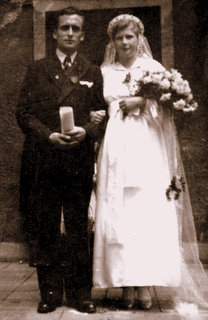
I have continued to research the subject over the past few years, and this post tells the story of Ralph Peck and his German bride, Ursula Ottow, who were married in the St Johannes church in Brunswick on 20 August 1946, earlier than any of the couples I have written about previously, or whose sons or daughters have added comments to earlier posts.

Ralph and Ursula  wedding photo

But Ralph and Ursula married without permission from the British authorities, and they did not realise that their church ceremony was not valid in German law, according to which church marriages must be confirmed in a civil registry office (Standesamt) before they are legally valid.

They were eventually officially married in the Standesamt in Goslar on 21 May 1947, nine months after their church wedding on 20 August 1946.

An extraordinary collection of documents preserved by Ralph’s son, Clive, which he has now donated to the Imperial War Museum, shows that even after the British government announced, on 31 July 1946, that the marriage ban with ‘ex-enemy nationals’ would be relaxed, it was still enormously difficult, time-consuming and stressful for a couple who wished to marry to understand the regulations, obtain all the necessary documents and finally receive permission to marry, in full accordance with British and German law.  

Ralph first met his future wife, Ursula, soon after the end of the war, and they decided to marry in December 1945, when British men serving in the armed forces or Control Commission for Germany (CCG) were still forbidden to marry ‘ex-enemy nationals’.

Ralph was born on 5 November 1919 and served during the war in the Royal Corps of Signals. According to his Soldier’s Service Book, he enlisted on 8 July 1940 and was employed as a clerk. He was promoted sergeant, awarded the Africa Star, was entitled to the Defence Medal, and served overseas, mainly in the Middle East, for a total of 5 years and 14 days. At the end of the war in Europe, in May 1945, he was in Germany, stationed in Brunswick, in the British zone of occupation.

Ursula was born on 15 April 1929 in Flatow in West Prussia, now Zlotow in Poland. Like many other Germans, she had fled westwards with her family ahead of the advancing Soviet troops.

The documents do not reveal when or how they met, but Ursula told her son Clive that it was soon after the end of the war, at a dance hall, and Ralph asked her to marry him the first time they met. She was only 16 years old at the time.

On 2 January 1946, Ralph wrote a letter, in German, to Ursula’s parents, asking for their consent to the marriage. Ursula’s parents now lived in Oschersleben, not far from Brunswick, where Ralph was stationed – but Oschersleben was in the Russian Zone of occupation. Travel between the Russian and British zones was difficult and required special permission, so they could not meet face to face. Ralph wrote that he hoped to meet them soon. As he was due to be demobilised and return to Britain in April and as he loved their daughter, he asked for their permission to marry and take Ursula with him to England. He added that he and Ursula would return to visit her parents every year, and would spend the next Christmas with them in Germany.

Ursula’s father, Alwin Ottow, replied to Ralph on 22 January 1946. He wrote that he and his wife were glad to hear that their daughter Ursula had met someone willing to make her his wife and this would, he added, help create a bridge of friendship between the British and German peoples. He welcomed the news and had no objections, but felt he had to express some concerns. Ursula was very young and inexperienced. She would be only 17 years old in April. She had no job, had not trained for any career, and had no possessions apart from the clothes she was dressed in. He also questioned how she would cope with leaving home and living in a strange and unfamiliar country. But, he added, the decision was theirs alone. At the end of the letter he asked for the wedding to take place in Germany, rather than in England, so that he and his wife could be present.

The couple announced their engagement on 5 February 1946.

On 18 March 1946, Ralph applied to the army authorities for permission to marry. He received a reply on 23 March 1946 refusing his request on the grounds that army regulations did not allow marriage with German women who had lived in Germany during the war.

Refused permission to marry by the army, Ralph thought that he could still marry Ursula after he was demobilised, if he returned to Germany as a civilian. He wrote on 27 March 1946 to the Home Office, Aliens Department, in London, that he wished to marry, as a civilian, a ‘young German girl’. He was due to be demobilised between 20 April and 17 May and intended to ‘seek immediate permission to return to Germany for the purpose of marrying the girl and returning with her to England’. He asked to be notified of the correct procedure to be adopted, adding that parental consent had been given for the marriage. If possible, he wished to arrange the marriage before his departure to England.

Around the same time, at the end of March, he applied to join the civilian Control Commission for Germany (CCG).

Ralph’s application was successful. He started work with the CCG and returned to Germany in July 1946, stationed initially in Brunswick and then at Goslar. On 22 July he wrote to the CCG Welfare Office in Lübbecke, a small town in Westphalia, stating that he was submitting his application ‘to marry a German girl’, adding that he had originally applied on 18 March 1946 while serving as a Sergeant in the Royal Corps of Signals, and the matter was not passed to higher authority then as ‘it was considered that there would be no possibility … of approval being given.’

He now asked if permission could be given at an early date, as he had returned to Germany as a civilian. If this was not possible, he asked if he could escort his intended bride home while on leave ‘where a home awaits her, where her arrival is eagerly awaited and her presence amongst my family would be that of genuine welcome’. He would then return to his job in Germany until a change of policy allowed German wives of Control Commission personnel to live in Germany.

Ralph received a reply dated 6 August 1946 from the CCG Civil Establishment Office refusing his request to marry, on the grounds that: ‘the position stated in C.E.O. Circular no. 36L of 14.12.1945 remains unaltered, and consent to marriage between civilian personnel of the Commission and Germans is in all cases refused.’

This reply is surprising as only a few days earlier, on 31 July 1946, the government had officially announced in London that the marriage ban would be relaxed. Presumably the news had not yet reached the British officials in Germany.

Despite not having received official permission, Ralph and Ursula decided to go ahead anyway, and were married in a church ceremony in the St Johannes Church in Brunswick on 20 August 1946.

But that was not the end of the story.

Trauschein

Ralph almost certainly did not know that when he and Ursula were married in church on 20 August, in Germany, unlike England, church marriages were only legally binding if they were confirmed at a government registry office (Standesamt). This had implications in Britain as well. According to British law, properly conducted marriages in foreign countries were accepted and recognised. But if a church marriage was not legally binding in Germany, it was not legally binding in Britain.

The documents in the files show that between the end of August 1946, after he was married in church, and May 1947, when the registry office marriage finally took place, Ralph desperately tried to find out what was the correct procedure, obtain the required documents, and meet the various conditions to be fulfilled, before he and Ursula were eventually married in full accordance with German and British law.

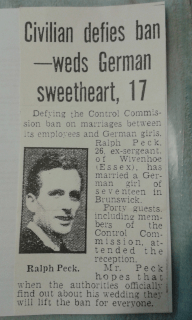
2016-11-25 17.29.04The church marriage was reported in the newspaper, the Daily Mirror, with a photo of Ralph under the headline: ‘Civilian defies ban – weds German sweetheart, 17.’ The text of the article ran: ‘Defying the Control Commission ban on marriages between its employees and German girls, Ralph Peck, 26, ex-sergeant, of Wivenhoe (Essex) has married a German girl of 17 in Brunswick. Forty guests including members of the Control Commission attended the reception. Mr Peck hopes that when the authorities officially find out about his wedding, they will lift the ban for everyone.’

It is interesting that according to the article, ‘members of the Control Commission’ attended the wedding and seem to have had no objections to it, despite the wedding taking place without official permission. But it is not known who were the guests at the reception, or how the Daily Mirror heard about the wedding.

On 4 September 1946 Ralph wrote to the London office of the Control Commission asking to be advised of the ‘correct procedure to be followed, in respect of marriages taking place between Control Commission personnel and German subjects, adding that ‘I have been unable to obtain any definite instructions of the correct procedure to follow regarding this matter, although I understand, notification as far as military personnel are concerned, has already been issued by army authorities.’

This suggests that by now, Ralph probably knew that the government in London had decided to relax the marriage ban. On 31 July 1946, a government spokesman had made a statement in the House of Lords that ‘local military Commanders should be authorised to relax the present ban on marriage between British servicemen and alien women … in cases where the reasons for marriage are good and there is no security objection.’

But although the decision in principle had been taken to end the marriage ban, it took many months until it was implemented in practice by the various military and Control Commission units in Germany. Ralph received a reply to his letter of 4 September from the Director of Organisation, Zonal Executive Offices in Lübbecke, dated 18 September, stating that marriages were not yet possible but the situation was ‘under active consideration’ and a general announcement would be made as soon as a decision had been made.

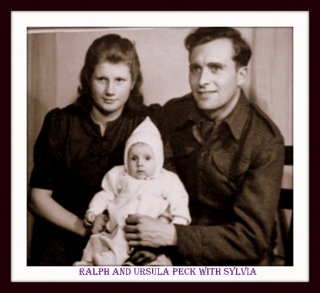
Ursula was now pregnant, and their daughter, Sylvia Lilian Gabriele was born on 22 November 1946.

Ralph  Ursula and Sylvia

Ralph may have first become aware that his German church marriage was not legally binding when he attempted to register his daughter’s birth.

He wrote on 17 December 1946 to the Civil Establishment Office for the CCG in Lübbecke and to the Passport Control Office in Berlin, asking for permission to ‘sign the Register’ at the Standesamt in Goslar in order to ‘complete my marriage’ adding that: ‘At present I am unable to obtain a “proper” birth certificate for my child and I have signed a certificate to the effect that ‘I am the father of my child’ pending authority requested above.’ He continued: ‘I wondered whether I could overcome the terrible strain and worry, which I have undergone for some very considerable time’.

He received a reply stating that conditions were still being formulated and he should wait until a general announcement was made.

On 1 February 1947, he wrote in desperation to his MP, Sir Stanley Holmes, asking for help. In the letter, he wrote that shortly after arriving in Germany, he ‘met and fell in love with a German girl’. He had applied to marry on 18 March 1946 but this was rejected on the grounds that the girl lived in Germany during the war. After enclosing details of further letters and copies of official instructions he added that: ‘So far [despite] all my repeated attempts to complete my marriage and return with my young wife and daughter to the UK, I remain where I commenced with my endeavours several months ago … You will fully imagine how difficult my present position is and, if it was not for the kindness shown to us by the wives of other English officials over here, I have grave doubts how I could have kept my wife and child sailing through these last damnable months.’

He received a reply on 8 February from Sir Stanley Holmes’ agent, saying that the MP was ‘abroad on an important business mission in connection with the export drive’ but the issue was being investigated and he would write to him again. It is not known if Ralph received a further reply, as there is no more correspondence from the MP in the archive.

The procedure to be followed by Control Commission staff wishing to marry German women was officially confirmed by Ralph’s military government unit in Germany in March 1947.

A daily routine order was issued by HQ R.B. Brunswick, on 28 March 1947, stating that marriages between ‘British subjects and persons of enemy or ex-enemy nationality or birth’ were now possible, adding that CCG employees who married without permission would be obliged to resign or be liable to dismissal from the CCG. The order continued by outlining the procedure that staff should follow if they wished to marry Germans and ‘retain their appointments in C.C.G.’ as follows:

  • Approval would not be given until six months after the date of the first application. After completing the required procedure, marriages could take place in a German registry office and ‘this marriage will be valid under German and U.K. laws’.
  • Applicants had to apply on form B.A.O.R. 120 for permission from their chief of division, supported by certificate of good character of the prospective bride, signed by the local German rgermeister (mayor) together with a certificate from a local Minister of Religion and two copies of the ‘Fragebogen’ (a questionnaire used to identify those who had been members of or had supported the Nazi Party).
  • Once official approval had been given by the British commander, an application had to be made to a senior German legal official, the ‘Oberlandsgerichtspräsident’, for a certificate that the British man was eligible to marry. (This was a requirement of German, rather than British law). The certificate should then be forwarded to the HQ of the appropriate British military government region.
  • Applicants might then be requested to attend in person before the British Consul General in Hamburg to complete the formalities of the Foreign Marriages Act 1906, (to confirm that the marriage was valid under British law). 
  • Once married, the couple had to live in officially requisitioned accommodation, which would be made available under the same conditions as for British families. Under existing rules, they were not permitted to live with the wife’s family or in other German accommodation, although this was being reviewed.
  • After taking up married quarters the wife would be treated in exactly the same way as a British-born wife, as regards entitlement to rations, travel etc.
  • No exception to the conditions would be made ‘on account of pregnancy or when a form of marriage has already taken place’.
  • Applications made previously should be made again, following the above procedures, but would be deemed to have been submitted at the date of the original application or 10 September 1946, (six months before the date of this order outlining the procedure) whichever was the later.

Ralph and Ursula were finally legally married two months later in a German registry office (Standesamt), on 21 May 1947, after he had obtained permission from a senior commanding officer, and had submitted certificates of health and good character for Ursula, signed by the Bürgermeister (mayor) and a minister of religion, a certificate of good health and freedom from disease signed by a doctor, together with four copies of a Fragebogen completed and submitted for security clearance.  The file is full of letters, memos, and certificates that had to be provided before the wedding could take place, as Ralph tried to work out the best way to ‘complete’ his marriage as quickly as possible and meet the various requirements outlined above.

Unfortunately, this story does not have a happy ending.

Their little girl, Sylvia Lilian Gabriele, lived for less than one year. She died in the children’s hospital in Bad Harzburg, near Goslar, on 30 June 1947, less than six weeks after they were legally married.

Ralph resigned from the Control Commission after a year’s service and his appointment was terminated on 19 July 1947.

He and Ursula travelled together to England and lived with his parents in Essex. Their first son, Clive, was born in April 1948 and a daughter two years later.

Ralph was not happy back in Britain. He joined the New Zealand air force, and Ursula joined him with their two children in New Zealand in 1952. But after arriving, Ursula fell ill with TB and could no longer look after the children. The marriage split up. Ralph returned to England with custody of the children. He remarried and died in 1997. Ursula remained in New Zealand.

On a happier note, nearly seventy years later (in December 2016 when the documents were donated to the Imperial War Museum) Ralph and Ursula’s son Clive was still in touch with his mother in New Zealand and with his father’s family.


References

R.G. Peck papers, Imperial War Museum documents, reference 26388.

Some of the most significant documents in the collection are listed below in chronological order:

  • 2 January 1946. Typed letter to ‘Herr und Frau Ottow’, signed ‘Ralph’, asking for their consent to the marriage.
  • 22 January 1946. Handwritten reply addressed to ‘Sehr geehrter Peck’, signed A. Ottow.
  • 5 February 1946. Handwritten engagement card.
  • 18 March 1946. Memo from Lt. Col. G.E. Aldridge, to AQ branch, HQ 5 Inf Div. stating that Sgt Peck had applied to marry a ‘German subject’. He had also applied for an appointment with the Control Commission and would like his wife to remain with him in Germany. He was due to be released from the army between 20 April and 17 May.
  • 23 March 1946. Memo from Lt. Col. AA & QGM, HQ 5 Inf Div, refusing Ralph’s request for permission to marry.
  • 27 March 1946. Letter from Sgt. Peck to The Secretary, Home Office, (Aliens Dept), London.
  • 22 July 1946. Letter to CCG Welfare Office Lübbecke, from W/O Mr. R. G. Peck, Legal Branch, 120 Mil Gov, B.A.O.R.
  • 6 August 1946. Letter to R G Peck, Legal Branch, 120 Mil Gov, from N. N. Ferguson, Civil Establishment Office, Zonal Executive office, CCG Lübbecke, refusing his request for permission to marry.
  • 20 August 1946. ‘Trauschein’. Certificate of marriage in a church ceremony, in St Johannes Church in Brunswick.
  • 4 September 1946. Letter from R.G. Peck to the Control Commission, London office, asking to be advised of the correct procedure to be adopted with regard to his marriage.
  • 18 September 1946. Reply from the ‘Director of Organisation’ for the Control Commission in Lübbecke, Germany, stating that marriages were not yet possible but the situation was ‘under active consideration’.
  • 25 September 1946. Article published in the Daily Mirror under the headline ‘Civilian defies ban – weds German sweetheart, 17’.
  • 17 October 1946. A letter from Mr R.G. Peck to the Passport Office in London, stating that he had married a ‘young German girl’ on 20 August 1946, giving his passport number and asking to ‘be advised [of] the procedure to now be adopted.’
  • 21 October 1946. A letter from Mr R.G. Peck to the Passport Control Office in Lübbecke, Germany, saying he wished to arrange travel for his wife, ‘a young German girl’, from Germany to England as he was due to go to the UK on leave the following month and would like her to accompany him.’
  • 25 October 1946. A letter to Mr Ralph Peck from the Passport Office acknowledging receipt of his letter of 17 October (above) and informing him that the London office could not grant passports to British subjects who were not resident in the UK. If he wished to obtain a passport for his wife, he should contact the British consul general in Lübbecke, Germany.
  • A further undated letter from Mr R.G. Peck to the Passport Control Office in Lübbecke referring to his letter of 21 October (above) adding that ‘Unfortunately, I must ask that his matter please be left in abeyance until such time as I receive permission to sign the Register at the Registry Office. At the present time, although having been through a Church Ceremony, my marriage in NOT as yet legal’. He understood that permission would be received within the next few days.
  • 26 November 1946. The birth certificate of Ralph and Ursula’s daughter, Sylvia Lilian Gabriele, stating that, on oral information received, the father was the ‘British Government Official, Ralph Guy Peck’, born on 5 November 1919 in London. He had confirmed his identity by showing his identity card and confirmed that he was the father.
  • 26 November 1946. A letter from Ralph Peck to the Passport Office in Lübbecke referring to his letter of 21 October (above), saying that he had not as yet been able to obtain the necessary permission to marry in accordance with German law but understood that arrangements were available for prospective brides to travel to the UK provided a marriage ceremony could be performed within a ‘stated period’ and asking to be advised of the necessary procedure.
  • 4 December 1946. A letter from Charles Smith MP to Mr R.G. Peck advising him that he had received his letter of 22 November (not in file) but Wivenhoe did not fall within his constituency of Colchester and he should write to the member for Harwich, Sir Stanley Holmes.
  • 7 December 1946. A letter from the ‘Passport Control Officer for Germany’ in Berlin to Mr R.G. Peck referring to a telephone conversation and advising him that if he was getting married in Germany, his wife would be a British subject and would not require a visa to travel to England. On the other hand, if she wished to proceed to England before she was married, he was unable to grant her a visa unless Ralph was resident in the United Kingdom and they were going to marry within two months of her arrival. He concluded ‘It is unlikely, therefore, that I can be of any assistance to you.’
  • 23 December 1946. A letter from N.N. Ferguson, for the Director of Organisation, Zonal Executive Offices, CCG in Lübbecke, to Mr R.G. Peck, advising him that in connection with his application of 4 September 1946 requesting permission to marry a German national (see above), in addition to obtaining permission from CCG he should also apply to the local German ‘Oberlandsgerichtspräsident’ (a senior legal official) ‘for dispensation from production of a certificate of eligibility to marry.’ He was told he should apply for this as soon as possible as ‘further delay to your marriage may otherwise be incurred when the general conditions governing the marriage of CCG personnel to Germans [are] announced.’
  • 30 December 1946. A further letter from N.N. Ferguson for Director of Organisation, referring to the letter from Ralph of 17 December (see above) stating that conditions for CCG staff wishing to marry a German national were ‘at present being formulated’ and ‘as soon as certain legal points have been settled, a general announcement will be made.’
  • 30 December 1946. A letter from Paul J. Heyne, ‘interpreter at Townhall’ in Brunswick to Ralph Peck, saying he had tried to speak to the inspector at the Oberlandsgericht but was unable to do so, as he was not in his office because there was no heating due to the shortage of coal. He would try again on 2 January.
  • 2 January 1947. A further letter from Paul Heyne to Ralph Peck stating that he had called in person to see the inspector, Herr Fay, at the Oberlandsgericht, adding that: ‘He showed me all the papers concerning your case. As early as 13 August 1946, [before the church ceremony on 20 August] … they had sent the application to Mil Gov Legal Branch Hannover region. Up to this morning the papers were not returned to Oberlandsgericht though many others have come back duly consented to.’
  • 4 January 1947. A letter from the Regional Personnel Officer for CCG, Lower Saxony to Mr R.G. Peck copied to the Rev G.A. Hyde, stating that he had been asked by the Rev Hyde to reply to Ralph’s letter of 17 December (see above). He had been in touch with [the zonal administrative offices in Lübbecke to try to find out about the ‘new instructions relating to marriage’, and had been told that the instructions were ‘in the course of preparation and consideration by Legal Division and will be forwarded in a few weeks.’
  • 20 February 1947. A letter from Ralph to Ursula, written as if sent from his home address, stating that ‘I have to advise you the following: I am free and willing to re-marry you within two months of your arrival in England. I have the necessary accommodation in England for you and baby and I am well in the position to maintain you both. All my love, your affectionate husband…’
  • 27 February 1947. A letter signed by Ursula to the Passport Control Office in Berlin, notifying them that she had a letter signed by her husband, that he was willing and free to ‘re-marry’ her within two months of her arrival in England. She also stated in the letter that they were ‘originally married on the 20th August 1946 in St. Johannes Church Brunswick’ and asking for assistance for her and her baby Sylvia, born on 22 November 1946, to travel to her husband’s home ‘where accommodation and means of maintenance are available.’
  • 1 March 1947. A completed copy of Ursula’s ‘Fragebogen’ (de-nazification questionnaire).
  • 4 March 1947. Letter from W.A. Manders of the police in Brunswick to the Passport Control Office in Berlin, forwarding various documents, providing details of Mrs Peck’s (i.e. Ursula’s) British Zone identity card and asking for help arranging an exit permit for her.
  • 8 April 1947. Letter from R.G. Peck to the Rev. G.A. Hyde, HQ Mil. Gov. Hannover Region, saying that Legal Branch had handed over his marriage documents. He took them to the ‘Oberlandsgerichtspresident’ who told him all was in order and he would send the certificate ‘for dispensation from production of a certificate of eligibility to marry’ to Legal Branch. However, the Standesamt in Goslar had ‘received no notification whatever that marriages between C.C.G. and Germans can take place’ and Ralph asked Rev Hyde if he had now complied with all ‘instructions issued’.
  • 10 April 1947. Memo from Ralph’s commanding officer, signed ‘Lieut. Colonel RA’, Commander of 214 Kreis Group HQ, Goslar, confirming that he had ‘no objection to the marriage of Mr. R.G. Peck taking place immediately’. The letter continued that as an application to marry was first made on 22 July 1946, ‘it would appear that Mr Peck has been eligible to marry since 10th March 1947.
  • 12 May 1947. Certificate of character by a Minister of Religion for ‘Miss Ursula Luise Ottow’ confirming she was ‘of excellent character and I can observe no objection whatsoever to her marriage with Mr R.G. Peck.’
  • 13 May 1947. Certified copy, in English and German, of a certificate of good character for ‘Miss Ursula Luise Ottow’ originally issued in October 1946 by the Bürgermeister of Oschersleben.
  • 13 May 1947. Certificate of security clearance for ‘Miss Ursula Luise Ottow’ signed by the British ‘Area Intelligence office’ confirming that ‘there are no security reasons why she should not be married to Mr R.G. Peck.’
  • Certificate of health for ‘Mrs Ursula Luise Peck, nee Ottow’ signed by a doctor in Hahnenklee (near Goslar), in English and German, confirming she was ‘free from venereal disease and tuberculosis.’
  • 16 May 1947. Formal marriage application, BAOR Form 120, signed by Ralph and Ursula on 1 April 1947, authorised by Brigadier Lingham, Deputy Regional Commissioner for ‘Land Niedersachsen’ (Lower Saxony) on 16 May 1947.
  • 21 May 1947. Official marriage certificate, issued by the registry office (Standesamt) in Goslar.
  • 6 June 1947. Memo from R.G. Peck to the British Consulate General in Hamburg requesting an emergency exit permit for himself, his wife and child to travel to Britain.


Transforming Occupation in the Western Zones of Germany: now available in paperback

31 March 2020

My second book, Transforming Occupation in the Western Zones of Germany an edited collection with contributions by sixteen international scholars from Britain, the USA, Germany, the Netherlands and Australia – all experts in the subject of military occupation and its social, political, economic, cultural and legal implications, has recently been published in paperback.

You can order the book, if you wish, from the publishers' website. The price, if you order online, is £20.29, a discount on the list price of £28.99, and much cheaper than the hardback.

Click here to read the contents and first chapter free of charge.


Winning the Peace: now available in paperback

3 December 2018

My first book, Winning the Peace: The British in Occupied Germany 1945-1948 has now been published in paperback.

You can order it, if you wish, from the Bloomsbury academic website.

The list price is £28.99, much cheaper than the hardback, and there are discounts if you order online.

Transforming Occupation in the Western Zones of Germany – the book

29 August 2018

My second book, an edited collection with contributions by sixteen international scholars from Britain, the USA, Germany, the Netherlands and Australia – all experts in the subject of military occupation and its social, political, economic, cultural and legal implications – is published this month by Bloomsbury Academic.

The idea for the book originated at a conference held at the German Historical Institute London in September 2016, that I organised jointly with a colleague, Camilo Erlichman, now Assistant Professor in History at Maastricht University. Camilo and I are the joint editors of the book and we wrote the first, introductory chapter on ‘Reframing Occupation as a System of Rule’. 

It seemed to us that when people write about a country or part of a country occupied during or after a war – such as Germany or Japan after the Second World War, the occupation of the Rhineland after the First World War, the wartime occupations by Germany of France, Belgium, the Netherlands, Denmark, Norway and much of Eastern Europe, or the more recent military occupations of Iraq or Afghanistan by the United States, to give just a few out of many possible examples – they normally treat the subject as an isolated, individual case, without thinking about military occupation as a subject in its own right, as a system of rule, with certain characteristics that apply to all cases, just as other systems of rule – such as liberal democracies, absolute monarchies, military dictatorships, or imperial colonies – also share certain characteristics.

Of course, different cases of military occupation are experienced by the local population, and by the ruling occupiers, in very different ways. Some occupations are oppressive and highly destructive; others are relatively benevolent. Some are very short, lasting only a few weeks or months; others can last for years or even decades. But in our view, we need to ask similar questions about all, and our understanding of any one case of occupation can be improved through comparing it with others. For example, questions that can and should be asked about all cases include:

– What were the origins of the occupation, how and why did it arise?

– How did the new rulers, the occupiers, manage the legacy of the previous regime that has now been superseded by the occupation?

– How did the local population respond to the occupation, did they cooperate, or resist, or both?

– What strategies of rule were adopted by the occupiers in order to maintain their power and authority, and establish their legitimacy as rulers?

– What legal framework did they adopt?

– What was the experience of daily life under occupation, for both occupiers and occupied?

– How did personal relationships between occupiers and occupied evolve, at all levels of society?

– How did the occupation evolve over time, and eventually end, how was power devolved or transferred from occupier to occupied?

– Did some social groups win or lose from the occupation?

– What were the most significant legacies of occupation – social, political, cultural and economic – for the countries concerned?

These are some of the questions we tried to address in the book, in the case of the three western zones of Germany, occupied by the United States, Britain and France after the Second World War.

Transforming Occupation in the Western Zones of Germany is an academic publication and priced accordingly, which means that it will be bought mainly by university libraries and other institutions, and read by students of the history of Germany and post-war Europe, and more generally, by researchers exploring occupation as a subject in its own right.

If you are interested and would like to know more, you can read the contents and the first chapter, written by Camilo Erlichman and myself, online, entirely free of charge. Follow the link at the end of this post.

And if you would like to read the whole book but cannot justify buying your own copy, please do request a copy from your local library?

Here are some extracts from early reviews of the book:

This is an exceptionally valuable volume that brings together a first-rate group of historians. It belongs on the bookshelf of anyone interested in postwar Germany or the long legacies of the Allied occupation.’

Adam Seipp, Professor of History, Texas A&M University, USA.

This outstanding collection sheds fascinating new light on many diverse aspects of the occupation of Western Germany after 1945. More than this, however, it asks that we rethink out understanding of occupation in modern history in more general terms. As such it will be crucial reading for scholars of political transition in a wide variety of different fields.’

Neil Gregor, Professor of Modern European History, University of Southampton, UK.

Often casting a critical eye on the planning and practices of the western powers, the authors recount fascinating stories of conflict and cooperation between victors and vanquished that reveal the contingency and complexity of the history of occupied Germany.’

Timothy Schroer, Professor of History, University of West Georgia, USA.


Transforming Occupation in the Western Zones of Germany: contents and first chapter

Order a copy from the publisher’s web site 


Winning the Peace – the book

17 January 2017

My book: Winning the Peace: The British in Occupied Germany 1945-1948 is published this month by Bloomsbury Academic. It is an academic monograph and priced accordingly, which means that it will be bought mainly by university libraries and other institutions and read by researchers studying the period.

But if you are interested, you can read the contents, introduction and first chapter online, entirely free of charge. Follow the link at the end of this post.

And if you would like to read the whole book but cannot justify buying your own copy, please do request a copy from your local library.

Here are some extracts from what it says on the back cover:

Winning the Peace examines the aims and intentions of twelve important and influential individuals who worked for the British Military Government in occupied Germany during the first three years after the end of the Second World War…

Winning the Peace strikes a balance between earlier self-congratulatory accounts of the British occupation, and the later more critical historiography. It highlights the diversity of aims and personal backgrounds and in so doing explains some of the complexities and apparent contradictions in British occupation policy…

This book is an innovative study for those interested in the Allied occupation, the post-war history of Germany and the study of military occupation generally.’

Reviews:

Approaching the British occupation regime in Germany through a range of biographies sheds a new light on the occupation regime itself … Christopher Knowles argues convincingly that the positive contribution of these people to the remaking of Germany after the Second World War should be recognised.’ Stefan Berger, Director of the Institute for Social Movements, Ruhr University, Bochum, Germany.

Investigating the collective biography of twelve officers, it considerably extends our knowledge of British policies by highlighting the wide variety of often conflicting ideas and strategies within the military and civil administration of Germany.’ Michael Schaich, Research Fellow and Deputy Director of the German Historical Institute, London.

Chris Knowles’ multi-layered appraisal of the aims, intentions and achievements of the British occupation of Germany through his examination of the diverse views and experiences of a sample of British generals, civilian administrators and young junior military government officers not only uniquely exposes and deconstructs the constraints on the occupiers and their potential for agency but also makes a significant contribution to the new field of occupation studies.’ Rebecca Boehling, University of Maryland Baltimore County, USA.

Winning the Peace: contents, introduction and first chapter

Order a copy from the publisher’s web site


A German museum director remembers the British ‘Monuments Men’

10 September 2016

On a recent visit to Germany, I was delighted to meet the distinguished art historian, Professor Johann Michael Fritz, an elderly gentleman, now 80 years old, who is an expert on medieval metalwork and an Honorary Fellow of the Society of Antiquaries of London.

Professor Fritz told me that his father, Dr Rolf Fritz, had been the director of Dortmund Museum from 1936-1966. The museum building was completely destroyed during the war, but the collection was removed for safe-keeping and stored in various locations around Germany.

After the end of the war, the collection was recovered, with the assistance of a number of British officers who worked for the ‘Monuments and Fine Arts’ branch of the Control Commission. The objects were taken to a nearby stately home, Schloss Cappenberg, where Dr Rolf Fritz organised exhibitions so that the collection was once again open for display to the public.

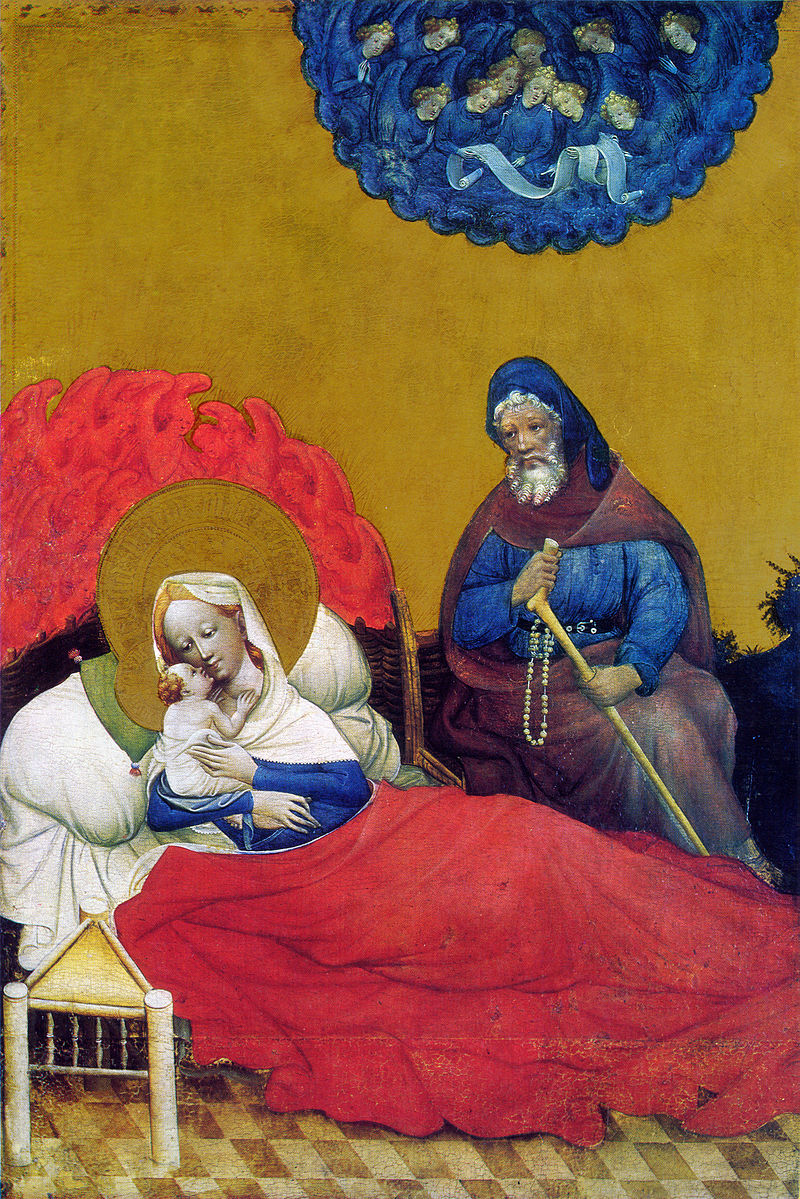
Some of the medieval works of art from Dortmund churches had also been removed and placed in storage depots. One of the most notable pieces recovered and displayed in Schloss Cappenberg was a late gothic masterpiece dating from 1420, a winged altar by Conrad von Soest, from the Marienkirche (St Mary’s Church) in Dortmund.

800px-Marienaltar-Linke-Tafel

The left wing of the Marienaltar by Conrad von Soest in Dortmund church (from Wikipedia).

Many years later, in 1990, Schloss Cappenberg was itself in danger after severe damage was identified, due to subsidence caused by extensive mine-workings underneath the building. It is located in the heart of the coalfields of the Ruhr. It has since been restored and is due to be reopened in 2017, after further renovation works have been completed.

In January 1991, a year before he died, Rolf Fritz wrote a letter published in the newspaper, the Frankfurter Allgemeine Zeitung. In the letter, he reminded readers of the role, now largely forgotten, of the British officers in recovering the collection and finding a home for it at Schloss Cappenberg, where it was displayed to thousands of visitors over the following years, before the museum re-opened in 1983, in a restored 1920s Art Deco building in the city of Dortmund.

The letter is reproduced below, together with excerpts from an article by Professor Fritz, describing how some of the relatives of the British officers involved heard about the letter and contacted his father, to thank him for remembering and acknowledging their contribution to preserving the museum’s collection of works of art, and enabling it to be displayed again at Schloss Cappenberg.

When I met Professor Fritz, I was impressed by two things he said. I asked him why it was important to spend so much time and effort recovering works of art, when the great majority of people at that time had more immediate needs; all were hungry, some starving, and many had nowhere to live. He replied, indirectly, by saying that he remembered visitors coming to the exhibitions organised by his father in Schloss Cappenberg, seeing works they remembered from years earlier, and saying ‘Die Sachen haben wir noch’ (these things – at least – we still have). When so much had been destroyed, and people had lost so much, they were grateful that some things, at least, had been preserved.

Professor Fritz also told me that, in his experience, a common interest in art is an excellent way of achieving international understanding (and reconciliation), as there are no language barriers and, sometimes at least, a shared love of the arts (or music) can bridge national, political, economic, and even cultural barriers.

The following is an excerpt from an article, to be published later this year, written in German by Professor Johann Michael Fritz. The article starts by reproducing the letter his father, Dr Rolf Fritz the former director of the Dortmund Museum, wrote to the newspaper, the Frankfurter Allgemeine Zeitung, in January 1991. The article also includes extracts from letters Dr Rolf Fritz received from relatives of the British Monuments and Fine Arts officers, who discovered his letter to the paper and wrote to thank him for remembering their contribution to the preservation of works of art in postwar Germany.


A reader’s letter and its consequences: on the work undertaken by English Monuments and Fine Arts officers in Westphalia after the end of the war, 1945.

By Professor Johann Michael Fritz

The events which are recounted here happened nearly seventy years ago. They took place in the years immediately after the end of the Second World War. But they were not entirely forgotten in the subsequent decades, thanks to an unusually long reader’s letter which was published in the Frankfurter Allgemeine on 16 January 1991. The author was Dr Rolf Fritz (1904–1992), then aged nearly eighty-seven. The letter reads:

‘The Saviours of Schloss Cappenberg

The essay in Bilder und Zeiten [the Frankfurter Allgemeine’s cultural section] “Seeing what our forebears once saw” in the issue of 8 December 1990, moved me deeply. I should explain who I am. I was from 1945 to 1966 Director of the Dortmund Museum of Art and Cultural History at Schloss Cappenberg. Recently there has been much discussion about the threatened destruction of the church and castle at Cappenberg through mining activity. But no one realises that after the war it was the English who prevented damage to the castle. This is what happened. Shortly after the end of the war, in May 1945, I had the difficult task of recovering and reassembling the extensive collections of the Dortmund museum, which were then at risk of further damage in the repositories to which they had been evacuated. The town of Dortmund was totally destroyed and nothing could be stored there, but an attempt had to be made to find a suitable place nearby. While searching I came across Schloss Cappenberg. Astonishingly, it remained undamaged, so I endeavoured to acquire it as a store for the museum collections. Opposition to this came from the English military government which wanted to requisition the large building as accommodation for mineworkers from the coalmines at Lünen, [whose houses had been destroyed in the war] while the local authority of Kreis Lüdinghausen urgently required it to accommodate its quota of refugees from Silesia. Against these demands the wishes of a museum hardly stood a chance. But the English military government had a Monuments, Fine Arts and Archives Department. It included Lieut. Col. Christopher Norris, an art collector and connoisseur, and the officers of his division: Major Robertson, in civilian life a lecturer in history of art at the University of Edinburgh, Major Murray Baillie, a member of an aristocratic family, and Major Mrs Westland, widow of an English general. All these officers were enthusiastically engaged in helping to rescue German monuments lying in the rubble, and rapidly joined forces with German museum and historical monument protection officials, as soon as these had returned from the war.

These English officers set to work with great energy, involving wearisome negotiations with English and German officials, and succeeded firstly in removing an English military unit, then in preventing the occupation of the building by refugees and miners, which, given the conditions at that time, would have involved serious damage to the fabric. Eventually [at the end of 1946] the entire castle (that is the central block and the west wing) was handed over to the museum as a depot and, as will be revealed below, as an exhibition space.

With their help it was also possible to organise the return of the collections from repositories scattered over the countryside. These men paid from their own pockets for the chemicals needed for the conservation workshop, which could only be acquired from abroad. This made it possible to begin work, even if only on a limited scale. With the officers’ help the altarpiece to the Virgin Mary [Marienaltar] by Conrad von Soest, which owing to its timely removal and storage had escaped the destruction of its church [the Marienkirche in Dortmund], was brought from the Lahn [in the French zone of occupation] to Cappenberg. It laid the foundations for the Conrad von Soest Exhibition in 1950, followed by numerous further exhibitions in the next decade. So one can rightly say that the survival of Schloss Cappenberg goes back to the initiative of those English officers – nearly all of them professional art historians – who regarded it as their duty to care for works of art and who felt such close links with their German colleagues that they energetically supported this difficult work in the first years after the war. Thanks to this support Schloss Cappenberg remained a site commemorating the Freiherr von Stein [its former owner, a Prussian statesman and administrative reformer] and became in addition a place for numerous and very varied exhibitions over many decades. Together with its precious church, it thus became a destination attracting many thousands of visitors.

Since then many years have passed and I can scarcely hope that those that gave their help at that time are still alive. I am all the more compelled to think of them with gratitude, as this help was offered at a time of great hardship, and particularly because what were then rescued – the castle and its jewel, the church of St Norbert – are today in the greatest danger.

Dr Rolf Fritz, Münster’

The article in the Frankfurter Allgemeine, to which the letter referred, and which prompted this letter, concerned the threat to Schloss Cappenberg and to the Romanesque church of St Norbert in its courtyard. A coalmine 1,000 metres below the building had caused such severe subsidence that there were fears that the church vaults might collapse. The letter which praised the English officers who had offered help immediately after the war, had mentioned four of them by name. Now something astonishing happened. Soon afterwards, several letters from Great Britain arrived, forwarded by the Frankfurter Allgemeine, from relations of the officers.

The first letter, dated as early as 13 February 1991 came from Lady Chapman, who had received a copy of Dr Rolf Fritz’s letter from the sister of Hugh Murray Baillie. Lady Chapman was the sister of Mrs Westland. Then on 7 April came a letter from Eleanor Robertson, the widow of Giles Robertson, and on 8 May 1991 a letter from Susan Hunting, the daughter of Christopher Norris. Some time later a letter arrived from Jerry Granger-Taylor, whom Rolf Fritz had no longer remembered. In these letters the English writers expressed their thanks and were clearly most delighted that some forty years later the work in post-war Germany by their relations, now all dead with the exception of Granger-Taylor, was so highly regarded by a German colleague.

Rolf Fritz replied fully to these moving letters, adding further details about their shared efforts to protect works of art.

His letter to Lady Chapman: 22 April 1991: ‘I well remember the collaborative work with the small group of English officers who had a small office in Münster and from there did all that was in their power to rescue old works of art, often in the face of incomprehension on the part of German and English officials. When the views of our English colleagues eventually prevailed, it was only due to their unwearying readiness to help. …. We always used the opportunity, in tours of the exhibitions and of the Romanesque church, to mention how grateful we were to the English officers for their help at Cappenberg. Despite all the difficulties, it was a fine time of shared activity. … It all happened more than forty-five years ago and most of the helpers are no longer among the living. But the memories of them and the feeling of gratitude for their help are still alive….’

His letter to Mrs Robertson gave further details:

‘Your husband then, that is in 1945, had an office in Münster in the building of the German army military intelligence, a building I knew well from the war years. I visited it often in my search for support for Cappenberg. It was by no means simple. But your husband managed to obtain a pass for me from the military government, with which I was able to travel in the luggage vans of the few trains then running. On one occasion the two gentlemen took me by car to Iburg, about 40 km from Münster as they wanted to see the castle and church. My wife lived there in a summer house in the wood, very primitive, but safe from bombs. In our poverty we had nothing to offer the visitors save for a few raspberries from the garden and some milk begged from a farmer. But they obviously enjoyed it more than the uniform army mess-food.

And I remember something else. The two officers came with me and a German driver to Burg Langenau an der Lahn, in the French occupation zone, where the museum had a depot. This was where the Marienaltar by Conrad von Soest from the Marienkirche in Dortmund was stored. The request from the two gentlemen that the French should return the altarpiece was successful and this made the later exhibition of the altarpiece at Cappenberg possible. I know that we drove to a French officers’ mess, where the English officers wanted to have lunch, while the driver and I had to make do with a piece of bread, as we were not allowed in the mess. But your husband was able to smuggle out a packet of sandwiches from the kitchen, which he brought to us in the car. At that time that was a big present…’

His letter to Mrs Hunting includes an account of a much appreciated study visit to England which Christopher Norris organised for Rolf Fritz and his colleague Dr Cornelius Müller Hofstede from Brunswick to see the ‘Cleaned Pictures’ exhibition at the National Gallery in London (1947-8).

‘It was a big discovery for us and an invaluable stimulus for our work. In addition, visits to other London museums and the hospitality of a club were most useful. During the war years and their aftermath we had lost contact with old works of art. Mr Norris was most helpful over all these visits, including one to the Director of the National Gallery, Mr Philip Hendy. But one of the very best memories of that time is of a trip with Mr Norris to Polesden Lacy, where he had a beautiful apartment with antique furniture in a delightful country house set in a large park. We found a table laid with valuable china and silver; Mr Norris had brought a roast chicken from London which was tastefully presented. After the celebratory meal we all went into the kitchen to do the washing up so that the china would not be handled by the cleaning woman. For us coming from a destroyed Germany, it was like a fairy tale, and quite unforgettable.'


I am grateful to John and Bridget Cherry, long-standing friends of Professor Johann Michael Fritz, for introducing me to this story and to Professor Fritz, and for translating the excerpt from his article from German into English.

Professor Johann Michael Fritz’s illustrated article will be printed and published in German later this year.


‘The Allied Occupation of Germany Revisited’

27 July 2016

One of the main findings of the Chilcot Enquiry into the Iraq war was that preparations for the aftermath were ‘wholly inadequate’. To quote Sir John Chilcot:

‘Despite explicit warnings, the consequences of the invasion were underestimated. The planning and preparations for Iraq after Saddam Hussein were wholly inadequate.’

This is not surprising. As I wrote in a post in this blog back in 2008, soon after I had started researching the British occupation of Germany after the Second World War:

I need only mention the word 'Iraq' to make the point that what happens after the end of a war can be at least as important as what happens during the war itself.

And as Dr Peter Stirk, Senior Lecturer in the School of Government and International Affairs at Durham University, wrote in his book, The Politics of Military Occupation, published in 2009:

Military occupiers have been consistently inadequately prepared for military government, even on those occasions where they have recognised the problem in advance and made great efforts to prepare for it, such as the Allied occupation of Germany and Japan at the end of the Second World War.

I have written before on this blog, and in a policy paper for History & Policy on Germany 1945-1949: a case study in post-conflict reconstruction about some of the lessons we can learn from British experiences in post-war Germany that are relevant to contemporary operations, such as Iraq and Afghanistan.

But there were differences as well as similarities. In the case of the Allied occupation of Germany, there was no lack of planning. Extensive preparations were undertaken, but the situation changed. Once the war was over, Field Marshal Montgomery, the Military Governor of the British Zone of occupation, and his colleagues found that planning undertaken earlier, and the directives and instructions they had been given by the politicians in London, were completely inadequate for the conditions they found once they arrived in Germany.

It was not that the planning undertaken was bad or wrong. Some of it was very useful. But the planners made some incorrect assumptions, such as that there would still be a functioning central German government in existence at the end of the war, that would accept and implement instructions given to it to it by the Allies, acting jointly through the Allied Control Council in Berlin.

And the planners failed to anticipate what the situation in the British Zone of Germany at the end of the war would actually be like, for example that instead of taking over the richest, most productive part of Germany, much of the zone would be a heap of rubble.

The problem they faced was therefore not, as the planners had expected, to restrict the level of German industry, but to build it up, so that German exports could pay for the food imports necessary to prevent starvation. Until that was done, the zone was a liability rather than the expected asset, costing the British taxpayer £80 million a year, (a very large amount in those days). Most of the cost was for food imports from the United States, required to secure the very low levels of rations in the zone of 1,500 calories a day – half the average consumption in ‘austerity Britain’.

The Chilcot Enquiry is therefore correct, but only partially correct. The problem was not only the lack of planning for the aftermath of war, but a failure to recognise that the outcome was bound to be uncertain, that assumptions might prove incorrect, that the situation might change, and occupying forces would need to be prepared for, and would have to respond to, circumstances that could not have been predicted before the decision was taken to go to war.

Until recently, the Allied and especially the British occupation of Germany after the Second World War has been a neglected subject. After a flurry of activity in the 1980s after official documents were released to the archives, interest in the subject faded away.

Since the Iraq war of 2003, there has been a revival of interest in the Allied occupation of Germany. Academic researchers, not only in Britain, but also in the United States, Germany, France and elsewhere, are now actively working on the subject, many in new and interesting ways.

Some of this new research will be presented at a conference I am co-organising, which will take place at the German Historical Institute, London, at the end of September: The Allied Occupation of Germany Revisited.

The conference is fully booked, but if you are interested in the subject, have a look at the conference web site. The Call for Papers, first issued in November 2015, describes the rationale for the conference; the programme shows the topics that will be covered; and the site also includes links to some fascinating early films, that go some way to showing what life was actually like in Germany immediately after the war.

We hope the conference will help to stimulate further interest in the subject of the post-war occupation of Germany, but also in the topic of military occupation generally. For example:

  • Can different cases of occupation, such as the different zones of occupation in post-war Germany be usefully compared to each other, and to other cases of occupation, such as post-war Japan?
  • What has been the legacy of occupation?

And to bring us back to Iraq, what is the relevance of the past to the present and to the future? What can we learn from the Allied occupation of Germany that is still relevant today?


Winning the prize of the German Historical Institute, London

26 November 2014

This blog is the story of my research for my PhD thesis on ‘Winning the Peace: The British in occupied Germany, 1945-1948.’

My first post was nearly ten years ago, on 1 October 2005, when I enrolled, as a part-time student, on the MA in Contemporary British History at the University of London. Two years later I started on my PhD. I finished my thesis and was awarded the degree in February this year (2014).

I heard recently that my thesis has been awarded the annual prize of the German Historical Institute, London, given for an outstanding thesis on German history (submitted to a British university), on British history (submitted to a German university), or some aspect of Anglo-German relations.

Receiving the prize is a great honour, above all for the recognition it gives to the subject of my work – the post-war occupation of Germany by Britain. This area has been neglected by historians in recent years, but I hope this will change, as scholars discover new and innovative approaches to the subject.

In January 2011 I tried to explain why I wrote the blog. I said that, at first, I wrote it for myself. I didn’t know if anyone would read the blog and I didn’t care. Even if no-one else looked at it, I thought it would be useful as a way of helping me get my thoughts in order.

Researching a history PhD is about writing as much as it is about reading, working in the archives, and learning more about your subject. Writing a blog helped me express my ideas, and select which aspects of my work were most important.

But I was also amazed at how many people discovered the blog, read it, added their comments, and sent me emails: students and other academics working on projects or researching similar subjects, people exploring their family history, a few individuals who were there in person and could tell me about their own experiences, and children of British fathers and German mothers, who met each other and married in occupied Germany after the war.

The earliest posts on the blog were on a variety of subjects: including post-modernism, bread rationing in Britain, and allowing historical sources to ‘speak for themselves’. I then discovered Humphrey Jennings’ documentary film on post-war Germany ‘A Defeated People’.

As I became absorbed in my PhD research, the posts became more focussed on post-war Germany under occupation and the twelve British individuals I researched, who all worked for Military Government or the Control Commission. 

More recently, as I came to the end of my research, I wrote about one or two topics that I found interesting, but had not included in my thesis, for one reason or another: such as the Craft of Research, the process of researching an writing a PhD thesis, and the extraordinary story of Sergeant Harry Furness, the first serving British solider in occupied Germany to marry a German.

I hope to continue my research over the next few years, working with other academics interested in developing new and innovative approaches to the study of the occupation of one country by another.

But this will be the start of a new story. The award of the prize of the German Historical Institute for my thesis seems a good time to bring this blog, which tells the story of my PhD, to a close.

This blog will remain open to anyone to read and add comments, if they wish. I hope it will provide a resource for anyone researching the occupation. But I do not propose to write any new posts. Please feel free to contact me by email, or ask any questions, which I will always try to answer.

List of previous posts: July 2011 – March 2014

Harold Ingrams and the ‘Aden Emergency’ 17 March 2014

The four stages of competence, or how history can help stop us forgetting the fundamentals and throwing the baby out with the bath water 20 February 2014

History and Policy 6 February 2014

‘Infantilisation’ and ‘Echoes of Empire’ 21 January 2014

‘Operation Butcher’ 1 July 2013

Marriage with ‘ex-enemy nationals’ (continued) 24 May 2013

‘Hunting for Democracy’ (continued) 2 April 2013

Collective biography 8 March 2013

The Craft of Research 12 February 2013

Colonel E H D (Eric) Grimley: ‘Hunting for democracy’ 7 August 2012

‘Winning the peace’: attempting to explain some of the contradictions in British policy in occupied Germany, 1945-1948 1 March 2012

International Socialists 5 January 2012

“We pour petrol on them” 21 June 2011

List of earlier posts: June 2011 – September 2009

List of earlier posts: June 2009 – May 2007

List of earlier posts: March 2007 – October 2005